The Gravel N Bones Universe
Nine albums. Four arcs. One hundred and fifty years of damnation, betrayal, and a love that outlasted Hell.
Nine albums. Four arcs. One hundred and fifty years of damnation, betrayal, and a love that outlasted Hell.
A shared dark-Western and Southern-Gothic mythology spanning more than a hundred and twenty years.
The Gravel N Bones universe begins on a Texas frontier farm in the 1870s and ends on a quiet stretch of farmland in the 1990s. In between lie one hundred and twenty years of stolen labor, broken brotherhoods, corrupt institutions, and damned men who chose violence and paid for it. It is a world where curses outlast their casters, where the Devil runs a long con on souls he doesn't actually own, where a swamp can think and remember, and where the only thing that finally outlasts Hell is a wife's grief.
The catalog contains nine albums. Four of them follow the same man - the Rider - across a hundred and fifty years of damnation and the slow uncovering of the truth about his own curse. Two follow Cain Holloway, a frontier killer who found love, lost it, rode east to become a vigilante preacher - and whose story now continues in the ongoing Cain Holloway Chronicles. One album follows an unnamed man set up by his closest friend in Blackwater Hollow. One follows a modern musician who signed his soul away at the crossroads on Highway 61. And one album, Graveyard Psalms, is the universe's anthology - a register of damned men, some of them folklore versions of stories told in full elsewhere, others standalone tragedies still waiting to be expanded.
The universe is bound together not by a single plot but by a moral logic. Damnation here is a matter of choice, not chance. Every protagonist made decisions that put them on the road they died on. Some were forced toward those decisions by institutional failure, by grief, by betrayal. None were innocent of the choice itself. And in this world, taking the proceeds of a crime you didn't commit makes you guilty of it. The grandson is no less damned than the grandfather. The brother who profits from the betrayal is no less marked than the brother who carried it out.
Below: the timeline, the four arcs, the mechanics that hold the universe together, and the cast.
From the 1870s frontier to the 1990s backroads - the universe's events in chronological order.
The central spine of the universe. Four albums. One hundred and fifty years. One unnamed man.
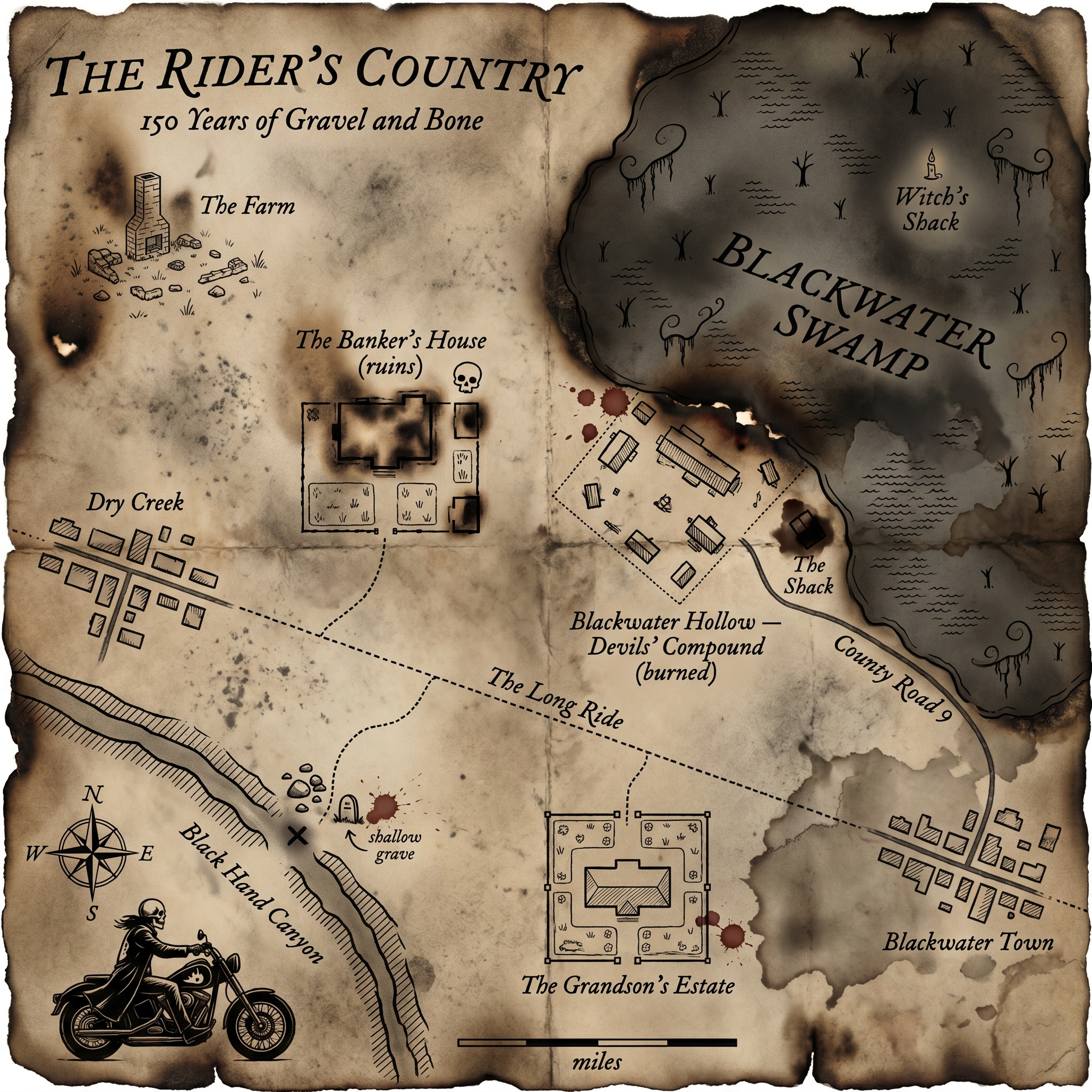
A young Texas farmer lives a simple life with his wife and son until the local Banker decides he wants the farm. When the Farmer refuses to sell, the Banker sends men to burn the place down with the family inside. The Farmer survives. His wife and son do not. In her final breath, watching her son burn in her arms, the wife calls on something old and deep - a power that predates Hell, predates the colonization of the land, predates language. Her grief binds her husband to her vengeance. He will not be permitted to rest until every man responsible is dead and every bloodline descending from those men has ended.
The Farmer joins the Black Hand outlaw gang, hunts down the Banker, and burns him alive in his own vault. He rides as an outlaw for years before being ambushed and killed in a canyon. He dies in a shallow grave at the bottom of the canyon - and rises with Hellfire burning in his chest, certain that the Devil has claimed his soul.
For the next decade he serves as Hell's enforcer. He hunts souls Hell has marked. He uses the fire on the damned and bullets on everyone else. He learns the rules. In a town called Blackwater, he is tricked by a witch into entering the swamp - and the swamp, which is a sentient elemental thing older than anything the Devil ever built, pulls him under and holds him there. For ninety years. Conscious. Aware. Pinned to the mud.
In 1973, a young biker named Jesse is murdered by his own motorcycle club president and crashes into the swamp. His body lands close to the Rider's. Hellfire transfers through Jesse's wound. The Rider rises in Jesse's body, takes over the Blackwater Devils Motorcycle Club, and spends the next twenty years running it - still Hell's enforcer, still convinced he is owned by the Devil.
Then a stranger with no shadow walks into the clubhouse and says four words that begin the unraveling: "She never let you go." The Rider rides back through his own history, returns to the canyon where he died, and finally to the swamp itself. There, the witch - who is the swamp wearing a body - tells him the truth she has been holding for a hundred and fifty years.
The Banker had a son no one knew about. The bloodline survived through generations. One descendant remains alive in 1993, living in a mansion built on the original farm's land, his fortune inherited from the violence that started everything. The Rider hunts him, ignores his protests of innocence, and burns him alive with Hellfire. "You took the money, you didn't mind."
The curse releases. The Rider rides back to the farm where it all began and dies, finally, in Jesse's body. His soul reunites with his wife and son. The album closes on a folklore image - some say on quiet nights, three figures can still be seen walking arm in arm across the old farmland.
A human-scale tragedy. Texas. The same frontier era. Different damnation.
Cain Holloway is the Rider's human-scale mirror - a damned man in the same world, but without supernatural mediation. He was a killer-for-hire across the Texas Panhandle and the Brazos, taking silver in lamplit rooms and sending sinners to unmarked graves. He stopped believing in much of anything around the third man dead. Then a rancher hired him to kill a cattle thief, and the rancher's daughter walked out into the yard alone and asked him to spare the man.
Her name was Lila. Cain spared the man. He married her. She made him eat at the kitchen table instead of off his knife in the dark. She hung his gun belt on a peg by the kitchen door and prayed over him while he slept. She told him, "You ain't just what you've done." And inside that house - though only inside that house - he was no longer a killer.
The reformation held until a widow named Mary Hardy rode three days alone to his porch with the story of her ten-year-old son Daniel, killed by the corrupt sheriff's son with all six rounds for trying to defend his mother. The badge protected the killer. No judge would ever convict. Mary buried her boy by a creek with her own hands. She offered Cain her last roll of bills. Cain sat on the porch step with his head bent, Lila silent in the doorway behind him, and turned the story over until he knew the answer wasn't going to come up fair.
He came inside that night and Lila said, "You're fixin' to go." She told him what they both already knew: if he killed the sheriff and his son, he could never come home. The Rangers would hunt him forever. She would not follow him into a hunted life. They didn't speak again that night. He watched her sleep. At dawn he took the Colt back down off the peg. They would not see each other again for five years.
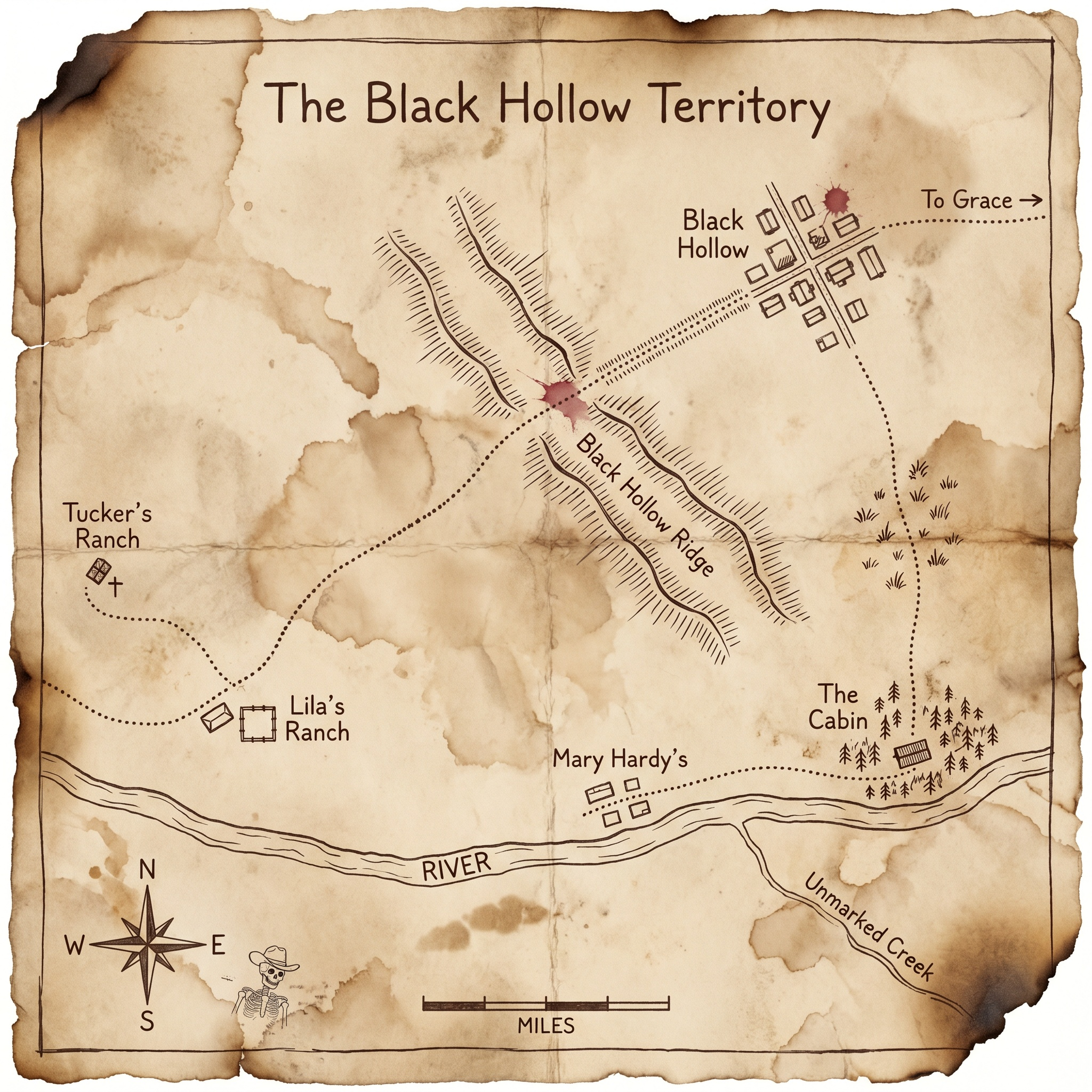
Cain rode three days west to recruit an old partner, Tucker Vance - a killer who had retired to grieve a dead wife on a small ranch. Tucker walked alone to his wife's grave, stayed there with his hat in his hands, and came back ready to ride. They rode for Black Hollow. The corrupt sheriff Hollis Crane - who had been quietly watching Mary Hardy for weeks and had seen her at Cain's porch - ambushed them in a pass. Four of Crane's men died in the rocks. Cain took a bullet to the side. They retreated to a cabin by a river.
A week later, Tucker rode for supplies and was caught by Crane's men on the return road. Crane personally whipped him to death with a bullwhip. Hung his body at the entrance of Black Hollow as a warning. Tucker died without saying where Cain was. Mary brought the news to the cabin at dawn.
When Cain could ride again, he passed Tucker's body at the entrance post and kept going. He walked into the saloon where Crane and his entire posse were planning how to hunt and kill him. The first shot took Crane between the eyes. The second took his son. The rest of the posse pulled their pistols too late. Cain walked into the street afterward and yelled his warning loud: any man he ever saw again dies, and so do their kin and their houses. Black Hollow watched him leave in silence.
He rode east from Texas with the blood still on his hands. He buried what he was at a creek in unmarked sand. He came to a town called Grace and never rode no more. He took the pulpit and the Bible, and he kept the Colt he always wore. The album ends where Preacher's Got a Gun begins.
That closing verse is how Grace still tells it. Chapter One is the truth underneath it - and it starts with a question fans carried out of the single Noon Train Comin': a hunted gunman gets a warning wire that six men are coming for his head, and the wire came from an old friend. The single never says who sent it. Cain Holloway sent that wire.
Five years into the pulpit, Cain hears that six hired guns passed through Grace on their way west to kill a man, and the name is Amos Pike - the partner he rode with in the killer-for-hire days, and the man who rode clear of the Denver payroll heist Cain himself planned ten years back. Cain owes him nothing. But a caught Pike names the man who drew up the job, so Cain walks to the wire office, pays his dime, and sends an unsigned warning west. Weeks of silence follow. Then word comes down the track: six men stepped off a noon train, not one rode back, and Amos Pike is alive and riding for Grace.
Pike traces the wire to the town, and the wire man points him to the church. He walks in, never takes his hat off, and laughs when he sees who's behind the pulpit. Right behind him comes Harlan Doss - a detective on retainer to the express company, ten years on the Denver job, a man who had Cain's name the whole time but never a town until Pike led him to one. His opening move is already made: his men are posted on Lila's ranch in Texas, and if anything happens to him, she dies. The demand is simple. Every dollar of the payroll back, or Cain, Pike, and Lila all pay. The problem is the gold was spent a long time ago.
So Cain does what Cain does best. He plans. One last lie - the gold is buried on her daddy's land - walks Doss and his guns straight to the one place Cain needs to be. A standoff in her yard buys proof of life: nobody digs till I see my wife. A night under guard gives Cain and Lila five years of unsaid words, the truth about the empty ground, and her answer to the last goodbye: this time there's no more goodbyes, live or die. She pulls her daddy's pistol from under a floorboard the company's men never found. Three guns now, and Doss's men only know about two.
At first light they dig. Cain lets his shovel ring, says nothing, and ten years of hunting jump into that hole after gold that was never there. What follows at the edge of the empty grave settles every account the album opened: the company's men, the detective who read Cain's file and folded too late, and the debt Amos Pike had carried since the noon train - paid when he steps in front of the bullet meant for Lila. He holds on long enough to see every company man dead, grins, and says the wire's paid. They bury him on the ranch, the last old friend Cain ever knew.
Lila could stay. The ranch is hers. She looks at Cain like he's lost his mind for offering, and they pack light and ride before dawn - hunted, together, her choice, with nobody watching from the doorway this time. Back in Grace they go on telling it the way they always told it: Lila lives in Texas, and he never saw her face again. Some stories are better left in place.
A betrayal tragedy on the same ground the Blackwater Devils later ride.
The narrator is unnamed. His brother-by-bond is also unnamed. They grew up on the same side of the same hard town, same dirt road, same drunken fathers. They shared a cell once and never spoke a word because they weren't the snitching kind. They fought for each other before they could shave and swore they'd be side by side in their graves. "That kind of brother don't come twice in a life."
They robbed a bank together on a Friday payday. Quick and clean. The brother knew a place to stash the cash until the heat died down. The narrator handed the bag over without a second thought. "That's the kind of trust a lifetime had bought."
Months later, the brother was caught by the law with a trunk full of methamphetamine. He cut a deal to save his own skin. To give the law a bigger fish, he engineered an elaborate two-stage frame-up of his closest friend. He paid three men to provoke a deadly bar fight, knowing the narrator would kill them and come running to him for help. He then sent the narrator to a shack in Blackwater Hollow - the same shack the Blackwater Devils Motorcycle Club would later operate next to - where the bank money had been planted as evidence. The deputies arrived in the night.
The narrator kicked the door and made his stand. Killed every deputy. Walked out of the hollow alive. Went directly to his brother's house, kicked that door too, and demanded the truth. The brother dropped to his knees and confessed: it was fear, not silver. He couldn't do the prison time. He cut the deal. The narrator pulled his knife and gutted him slow. "Born of the same dirt - that's how a traitor dies."
The narrator ran with the bank money, knowing the law would never stop. He made it to one more standoff. Threw the money bag high in the air, came out shooting, and died in the open with bullets scattered around him in the dust. His body fell on the same ground the Blackwater Devils would later ride. His blood and his story became the local folklore that whispers through Blackwater Hollow to this day.
A modern crossroads case. Same Devil, same play, one hundred years after the frontier.
The protagonist is unnamed across all ten tracks. Born dirt-poor in the late-'70s South with nothing but a pawn-shop acoustic and a hunger to get rich and famous by any means. Rolled past his county line before dawn with forty dollars in his jeans and a guitar on the seat, sensing something waiting down the road.
No label would sign him. Years of grinding run-down honky tonks town to town. One night the only man who stayed in a near-empty bar was an old itinerant bluesman who told him plain: "There's a crossroads out in the dead of night. Sign your name in blood, and your soul's signed away. He owns it when you die, but the fame starts today." The kid laughed him off as a drunk telling a crazy tale and walked. Seed planted and forgotten.
Five more years of small stages and empty pockets. A label man hyped him, took his card, ghosted him for a month. Driving home broke at dawn, the old man's words came back. "What have I got to lose?" He turned south and hunted the bluesman through every joint in the Mississippi Delta. About to give up, he walked into one last bar and the old man was already sitting there, like he knew the kid was coming. The directions were plain: Highway 61, where two roads cross, midnight, stand and wait. The kid felt a cold chill and something in the old man's eyes said run - but the hunger won.
He drove out, killed his headlights at the empty crossroad, and stepped out to be found. Two red eyes opened in the dark. A shadow stepped out and the cold rolled in. The Devil held out a book bound in black and said the terms plain: "Sign in blood, there's no givin' it back. You'll get the fame, the gold, the name, and when you die, your soul's my claim." The kid cut his hand, signed his name in blood, the page burned red, the book slammed shut. The Devil was gone. The cut had already healed. The deal was real.
The phone rang the next morning - big label out of the blue. His first record shot up the charts. Sold-out arenas before the tours started, fifty thousand a night, mansions and Cadillacs and gold records wall to wall. Ten years of the rise. But the man in the mirror was a famous stranger with a name he didn't own. The crowd screamed a name that wasn't his. The songs he wrote broke meant nothing in his mouth. And he lay awake counting days, tortured most by the open clock - nobody had ever told him how long he had.
He walked out of a sold-out show mid-tour, left the money and the mansion and his name in lights, and drove all night back to the fork on 61 to beg. Midnight came. The cold rolled in. And what walked out of the dark wasn't the Devil in his own form - it was the old man, grinning. It had been him all along. Every step. Every place. The kid dropped to his knees in the road and begged: take it back, give me my soul. The Devil laughed long and loud: "A deal's a deal, boy. You got what you chose. I warned you that night. That book stays closed." Then gone. Driving off with nowhere to go, his headlights hit a sign that read BLACKWATER TEN MILES. His last idea formed on the spot: run to God. Maybe God's forgiveness could outbid the ledger.
Blackwater didn't know his face. The old church on the hill had been empty for years. He picked up the Book and answered on his own, unordained, and preached for five years - fed the poor, prayed for the sick, buried the dead - hoping the work would save him. In the same town where the 1880s crossroads preacher hid and burned, a century later, a second damned preacher stood at the same pulpit hoping the same trick would work. It didn't.
One Sunday evening the sky turned blood red. Engines rumbled from way down the road. A dozen black Harleys pulled up to his church and cut their motors dead still. The Rider - running the Blackwater Devils MC in Jesse's body - had come to collect. He walked to the pulpit with the fire in his chest. Our preacher took the 1880s preacher's stance: defiant but knowing. He never begged. "A deal's a deal in the end and the Devil got my soul." The fire took him where he stood. His voice carried through the flame.
The universe's anthology. A register of damned men. Legends, seeds, and standalone tragedies.
Graveyard Psalms functions on two levels at once. Some of its tracks are folklore-compressed versions of stories told in fuller form on other albums - "Devil's Dust" is the legend version of the Rider's story, "Hell in the Hollow" is the legend version of the Requiem events, "Preacher's Got a Gun" is the legend version of Cain Holloway's life in Grace, and "Crossroads and Coffins" is the legend version of the modern crossroads case told in full on At the Crossroads. Other characters in the universe encounter these legend versions, not the full events. When the Blackwater Devils Track 2 says "the stories left behind still whisper the blame," those whispered stories are the same ones that show up on this album.
The other tracks are standalone tragedies - complete stories about damned men whose full albums have not yet been written. Empty Bottles tells the story of an outlaw betrayed by the lover he trusted. Ashes of the Outlaw Saint tells the story of a priest who walked away from his collar after his daughter's murder and died with a rifle in his hands. The Last Ride and The Gallows Don't Wait, the album's closing pair, tell one man's tragedy across two tracks - the night before he commits a murder he knows will hang him, and the morning of his execution, where the cuckolded husband's "righteous anger" framing of the first song unravels into the gallows-clarity admission of the second: "She was better than me in every way. But I broke the world that begged her to stay." Rattlesnake Gospel tells the story of a stranger who walked into a snake-handling cult and killed the corrupt preacher in the name of his own private gospel.
Each of these standalones is a seed. Any of them could be expanded into a full album the way "Hell in the Hollow" became Hell in the Hollow: Requiem. The universe's roster of damned men is not finished. Graveyard Psalms is the catalog of what is still to come.
How the supernatural works in this world. What is real, what is borrowed, and what predates Hell.
The central supernatural force in the universe. Cast by the Rider's wife in her final breath as she watched their son burn in her arms, the curse calls on something old and deep - an elemental magic that predates Hell, predates colonization, predates language. Her grief and rage are transmuted into Hellfire and bound to her husband's chest. He is her weapon. He cannot rest until every man responsible for the burning is dead and every bloodline traceable from those men has ended. This binding lasts one hundred and fifty years. The Devil did not create it. The Devil cannot break it.
The Devil is not a defeated dark lord or a monstrous antagonist. He is a parasite who exploits supernatural bindings he had nothing to do with creating. When the wife's curse trapped the Rider on this side of death, the Devil saw a soul that couldn't move on and claimed the brand. For one hundred and fifty years he ran a con on the Rider - pretending to own him, using him as Hell's enforcer, taking credit for the fire in his chest. When the Rider finally confronts him in the canyon, the Devil walks away rather than fight. "I never made you what you are. Go ask the swamp." He is small and embarrassed when exposed. A hustler caught with stolen goods.
The implication runs much wider. The Devil's parasitic model likely applies to every Hell-servant across human history. Most of them are probably bound by curses he exploited rather than created. Hell's roster runs on stolen labor.
The fire that lives in the Rider's chest. It can be projected through his hands to burn marked souls to ash. It cannot be used on the unmarked - if the Rider tries to use it on an innocent or unrelated man, it fails. He has to use bullets for those. The fire is technically not the Devil's; it is the wife's grief, transmuted. The Devil claimed it. He never owned it.
A sentient elemental entity, older than Hell. The swamp can think, remember, hold grudges, and act independently. It can also manifest in bodies - the figure called "the Witch of Blackwater" is the swamp wearing a body. The Old Woman with the Shovel who prophesies the Rider's downfall is also the swamp. The voice that speaks the truth in the Final Flame is the swamp again. Killing one of these bodies does not kill the swamp. The swamp is a place, not a person.
The swamp has been collecting damned men for generations. The Rider is one of many it has held. Other men have come voluntarily to die in its waters to escape cosmic judgment - the song "Bury Me in Blackwater" is one such voice. The swamp is not antagonistic to the Rider. It opposes the Devil's exploitation of him. The Rider's ninety-year imprisonment was, in a strange sense, protective custody - keeping him out of Hell's labor pool while the bloodline played out.
The Rider is not unique. Hell has had a small but historically continuous roster of cursed enforcers active across all of human history - Roman times, the Crusades, the Black Death, the frontier era, the modern world, presumably the present day. The Witch refers to previous ones. In the Blackwater Devils album, another Hell-servant appears on the highway as a messenger. In the Final Flame, the Devil sends an older-era rider on a black horse to silence the Rider before he uncovers the truth.
A separate supernatural mechanism. Souls can be sold to the Devil voluntarily in exchange for fame, glory, riches. Once made, the deal cannot be undone. The preacher in The Damned Still Ride and the narrator of Crossroads and Coffins are both crossroads-deal souls being collected by Hell's servants. This is a real mechanic in the universe, distinct from the parasitic con that binds the Rider.
A trickster figure who appears at moments of cosmic significance. He casts no shadow. He likes to stir the pot - not for justice, not for redemption, just because watching the Devil's con unravel amuses him. He is the stranger with no shadow who walks into the Rider's clubhouse in the Final Flame and plants the seed that begins the unraveling. He may have shown up at other Hell-servants' awakenings across history. He is available as a recurring figure in any era of the universe's mythology.
Stories in the Gravel N Bones universe get retold by the people who live in it. Around fires, in bars, in church gossip. Over time they compress. Details are lost. Endings get changed. By the time the legend is fully formed, the true events may be unrecognizable. The Hell in the Hollow narrator died in a final shootout with the law, not in the shack - but by the time the story reached the Blackwater Devils era in 1973, it had been compressed into "he died in the cabin." This is how the universe works. Other characters in the world encounter the legends, not the full albums. The Graveyard Psalms tracks are these legend versions, and the full albums are the truth behind them.
The universe has a strong recurring pattern of trusted-figure-as-betrayer. Empty Bottles, the Blackwater Devils' Prez ordering the hit on Jesse, the brother in Hell in the Hollow: Requiem, the partner in Ain't No Grave Deep Enough - all of them follow the same archetype. The betrayer's motive is always fear, never silver. They sell their brothers to avoid prison, to avoid death, to avoid consequences. The universe's central moral question, asked in Graveyard Psalms and answered in Requiem, is: "Was it fear or silver that made you choose?" The answer is always fear.
The single clearest moral statement in the universe is the line the Rider speaks to the Banker's grandson before burning him alive: "But you took the money, you didn't mind." In this world, complicity through inheritance is guilt. Living off the proceeds of a crime your family committed - even if you did not commit it, even if you did not know the full extent of it - makes you guilty of it. The grandson is not killed unjustly. The Rider's 150-year audit ends at him because he is the last man who chose to take the money without asking where it came from.
The major figures of the universe. Many are intentionally unnamed.
The unnamed protagonist of the Rider Saga. A simple Texas farmer until his wife and son were burned alive by the Banker's men. After their death he joined the Black Hand outlaw gang, killed the Banker, and was eventually ambushed and killed in a canyon. He rose with Hellfire in his chest and served for a hundred and fifty years as what he believed was the Devil's enforcer. His real binding was his wife's dying curse. He has worn many names over the years - the Farmer (dead), the Black Hand, Hellfire, the Rider, the Devil's Dust, the Trail of Crows, eventually Jesse after the 1973 reincarnation. He has no name of his own. The lack is itself characterization.
Permanently unnamed across all four Rider Saga albums. The most important character in the universe despite having almost no on-page dialogue until the closing track. Her grief and her dying curse outranked Hell. The fire in the Rider's chest is hers. The reunion at the end of the saga is the only thing the universe ultimately rewards.
Permanently unnamed. Burned to death in his mother's arms when their farm was destroyed. Reappears with his mother at the end of the Final Flame.
The original villain. Tried to buy the Farmer's land. When refused, sent men to burn the family alive. Killed by the Farmer in Saga of the Damned - burned alive in his own bank vault. His bloodline survived through generations via a son no one knew existed.
A manifestation of the Blackwater Swamp itself. The swamp wearing a body. She has no fixed form because she is not a person; she is a place. She bound the Rider to the swamp for ninety years - not as an antagonist, but as a counter to the Devil's exploitation of him. She delivers the truth of his curse in the Final Flame.
Sergeant-at-Arms of the Blackwater Devils Motorcycle Club. Murdered in 1973 by his own paranoid Prez. His Shovelhead crashed into Blackwater Swamp. His body landed close enough to the Rider's that Hellfire could transfer through his wound. The Rider inherited his memories - but Jesse's soul was gone in the transfer.
Not a defeated dark lord. A parasite who exploits supernatural bindings he didn't create. Has multiple modes of manifestation - a hand from a pit, a brand of fire, messenger proxies, a confrontable physical form in the canyon. When exposed in the Final Flame, he walks away rather than fight. Small. Embarrassed. A hustler caught with stolen goods.
Stirs the pot for his own amusement, not for justice or redemption. Walks into the Rider's clubhouse with no shadow, plants the seed that begins the unraveling, and vanishes. Available as a recurring figure across any era of the universe's mythology.
The only person in a hundred and fifty years who knew what the Rider truly was and chose to be loyal to him anyway. "I don't care what lives in your chest - you're my president." Dies in the Track 5 massacre when the Devil sends a black-horse Hell-servant to silence the Rider. His death is the cost of the Rider's awakening.
Frontier-era killer-for-hire reformed by love, called back to violence by another woman's grief, exiled from the home he built. After killing the corrupt sheriff Crane, his son, and the entire Black Hollow posse, he rode east to a town called Grace and became the vigilante preacher of "Preacher's Got a Gun." In Chapter One of the Chronicles, an unsigned warning wire drags his buried past into his church - and it comes out that Cain was the mastermind of the Denver payroll heist ten years back, took his cut, and has been on the company's books ever since. He never reforms. He is a killer of bad men and stays one. At the end of Chapter One he rides out of Texas with Lila at his side, hunted and free, while Grace goes on telling his legend wrong. The Chronicles are ongoing.
Cain's wife. Cattle rancher's daughter. The woman who said "You ain't just what you've done." Watched from the kitchen doorway as Mary Hardy told her story. Refused to follow Cain into a hunted life and sent him away. Knows everything he did at Black Hollow - the saloon massacre, Tucker's death, all of it. By Chapter One her father is dead and the ranch is hers. When the company's men took her land she hid her daddy's pistol under a floorboard before they swept the house, and when Cain told her the truth she took it out and said she was in the fight. She kills company men in her own yard, buries Amos Pike on her land, turns down the chance to stay safe, and rides out with a killer knowing exactly what he is. "You ain't leavin' me behind."
The widow from Black Hollow. Mother of Daniel Hardy. Buried her ten-year-old son by a creek with her own hands. Rode three days alone to Cain's porch with her last roll of bills. Later provided the riverside cabin where Cain and Tucker recovered from the ridge ambush. Brought the news of Tucker's death to Cain. Not the same woman as Lila - they are two distinct characters.
An old killer who had retired with a dead wife buried on his ranch. Cain rode three days west to recruit him for the Black Hollow job. Tucker walked alone to his wife's grave to make the decision - "what he said to her out there I'll never come to know" - and came back ready to ride. Whipped to death personally by Hollis Crane after being captured returning from a supply run. Died without saying where Cain was. Hung at the entrance of Black Hollow as a warning. The universe's most heartbreaking secondary character.
Sheriff and cattle-baron of Black Hollow. The prototype for institutional evil in the universe. His son murdered Daniel Hardy with impunity because of the badge. Crane had spies watching Mary Hardy and used her connection to Cain to plan a weeks-long ambush at the ridge. Personally whipped Tucker to death. Killed by Cain with the first shot in the saloon massacre.
The narrator of the single "Noon Train Comin'" and the old partner Cain rode with in the killer-for-hire days. Rode the Denver payroll heist Cain planned and was the only one of six who rode clear - and he rode clear with the gold. His whole life was a pattern of riding away from people. Warned by Cain's unsigned wire, he killed all six men the company sent off the noon train, traced the wire to Grace, and walked into a church to find the deadliest man he ever rode with holding a Bible. He owed Cain his life and had nothing to pay it with but himself. At the ranch he swung a shovel, took a rifle, and fought beside the man who saved him - and when a company gun drew a bead on Lila, the man who spent his whole life riding away didn't think twice. He jumped in front of the bullet meant for her, held on until every company man was dead, grinned, and said the wire was paid. Buried on Lila's ranch. The last old friend Cain ever knew.
A detective on retainer to the express company that lost the Denver payroll. Ten years on the case. He had Cain's name the whole time and never a town, until following Pike handed him one. Doss never threatened anybody - he read from a file. His shield was leverage: men posted on Lila's ranch before he ever rode into Grace, her life the price of anything happening to him. Not angry, not wronged, on salary, and that made him worse than Crane: a grudge can be satisfied, a man on salary does not stop. His one flaw was greed. When a shovel rang against something in an empty hole, ten years of hunting jumped in after it. He surrendered his men because he had read exactly who was holding the gun under his chin - and died last, on his knees, mid-sentence. "Ten years you hunted me down. Well you found me. How you like me now."
Unnamed throughout. A man with one good friend "born of the same dirt." Robbed a bank with his brother. Was framed by the same brother through a two-stage scheme - the engineered bar fight, then the shack with the planted money. Survived the deputy ambush, killed his brother in revenge, and died in a final standoff with the law in Blackwater Hollow. His blood and his story became the local folklore.
The Requiem narrator's lifelong friend. Caught by the law with a trunk full of meth. Cut a deal to avoid prison. Engineered the entire frame-up out of fear. Gutted slowly by the narrator in The Reckoning. "Born of the same dirt - that's how a traitor dies."
The locations that hold the universe together.
The central cursed location. Deep South aesthetic - cypress, Spanish moss, dark water. A sentient elemental entity that thinks, remembers, and manifests in bodies. Held the Rider for ninety years. Has been collecting damned souls for generations. The swamp's voice is the Witch. The swamp's land is Blackwater County.
The small town adjacent to Blackwater Swamp. The setting of The Damned Still Ride's middle tracks. Survives into 1973, by which point the Rider's story has become local folklore that old folks whisper about and children avoid.
A specific area within Blackwater County. The setting of Hell in the Hollow: Requiem AND the later compound of the Blackwater Devils Motorcycle Club. The same geography hosts both stories, separated by years. The shack from the Requiem is the same shack referenced in the Devils' Track 2 - "the old shack nearby still carries the stain, where men bled out and betrayal carved its name."
Where the Rider was ambushed and killed in his original life. His shallow grave still marks the floor. He returns to this place in the Final Flame to confront the Devil - and the Devil walks away.
The original site of the burning. Where the wife and son died. Where the curse was cast. Where the Rider returns at the end of the Final Flame to die in Jesse's body. The reunion happens here. Some say on quiet nights, three figures can still be seen walking arm in arm across the old farmland.
A town in Texas. The domain of Hollis Crane. Where Daniel Hardy was murdered, where Tucker Vance was whipped to death and hung, where Cain Holloway wiped out the entire Crane operation in a single saloon. Not the same place as Blackwater Hollow. Different state, different aesthetic, coincidental name overlap.
The town east of Texas where Cain Holloway becomes the vigilante preacher of "Preacher's Got a Gun." Exact location deliberately unrevealed. In Chapter One of the Chronicles, Cain leaves Grace without a goodbye - the Book left on the pulpit to gather dust, the Colt kept - and the town never learns what became of him. Grace goes on telling his legend the way it always has, which suits two hunted people just fine.
Her daddy's cattle ranch, hers now - she buried him alone during the five years Cain was gone and has run the land ever since. The same ranch where Cain first laid eyes on her, back when her father hired him for a killing and she crossed the yard alone to stop it. In Chapter One it becomes the stage for everything: the company's men hold it, the lie about buried gold leads Doss to it, the standoff, the reunion, the empty hole, and the massacre all happen on its ground. Amos Pike is buried there. Cain and Lila ride away from it together.
The road where Jesse was ambushed by his own M.C. in 1973. Runs near Blackwater Swamp. The site where the Rider's reincarnation began.
The bigger picture. What this world is actually about.
The Gravel N Bones universe is built on a few load-bearing ideas. The first is that damnation is a matter of choice, not chance. No protagonist in the catalog is taken against their will. The Farmer chose violence after the burning. Cain chose violence when Mary brought him Daniel's story. The Hell in the Hollow narrator chose violence in the bar, then again at the shack, then again at his brother's house. Hell does not draft. Hell hires. The men in this world walked through the doors that opened for them.
The second load-bearing idea is that institutional power and personal cruelty work together. The Banker had the law on his side. So did Crane. So did the Prez of the Blackwater Devils. The universe's villains are never just evil - they are evil with an office, evil with a badge, evil with a cut of the patch. When the protagonists kill them, it is not just personal revenge. It is the only audit the world will ever provide.
The third idea is that love is heavier than damnation. The wife's grief outranked Hell. The whole hundred and fifty year saga of the Rider is, at its core, the story of a man being held in the world by his wife's refusal to let him go. The Devil's con held for a century and a half not because the Devil was strong, but because the truth - that her love was the binding all along - was hidden from the Rider. When he learns it, the universe re-organizes around it. The reunion is not a redemption arc; it is a homecoming. He was always going home. He just spent a hundred and fifty years not knowing it.
The fourth idea is that the universe is layered. What other characters in the world hear is not the truth - it is the legend. Stories compress over time, get retold, get mythologized. The Graveyard Psalms tracks are these legend versions. The full albums are the truth behind them. There is always more under the surface. Always another version of the story being whispered around a different fire.
The fifth idea is that the universe is not finished. The Graveyard Psalms anthology contains multiple seeds for albums that have not yet been written - the priest of Ashes of the Outlaw Saint, the Faustian fall of Crossroads and Coffins, the cuckolded husband of The Last Ride and The Gallows Don't Wait, the drifter of Rattlesnake Gospel. The Hell-servant class spans all of human history, which means future albums could be set anywhere from ancient Rome to the present day. The Faustian fall of Crossroads and Coffins has already grown into a full album, and the Cain Holloway Chronicles have begun - Cain and Lila are out there right now, riding hunted, with the company's ledger still open and more chapters to come. The Angel of Death is still out there stirring pots. This is the beginning of a long mythology, not the end of one.
The full universe lives in the music. Nine albums waiting for you.
« Back to the Music