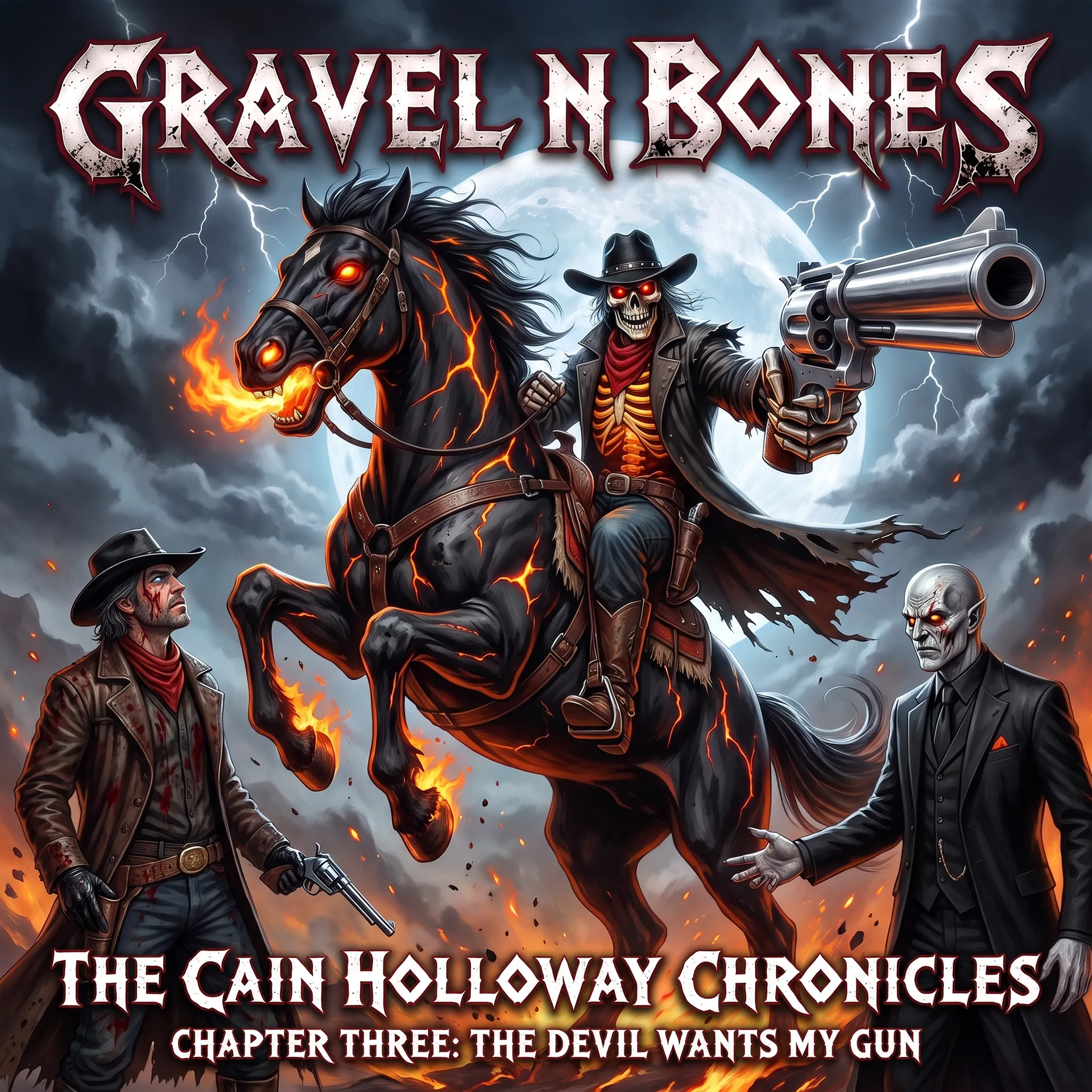
Gravel N Bones
The Cain Holloway Chronicles
Chapter Three: The Devil Wants My Gun
OUT NOW · Released October 10, 2026
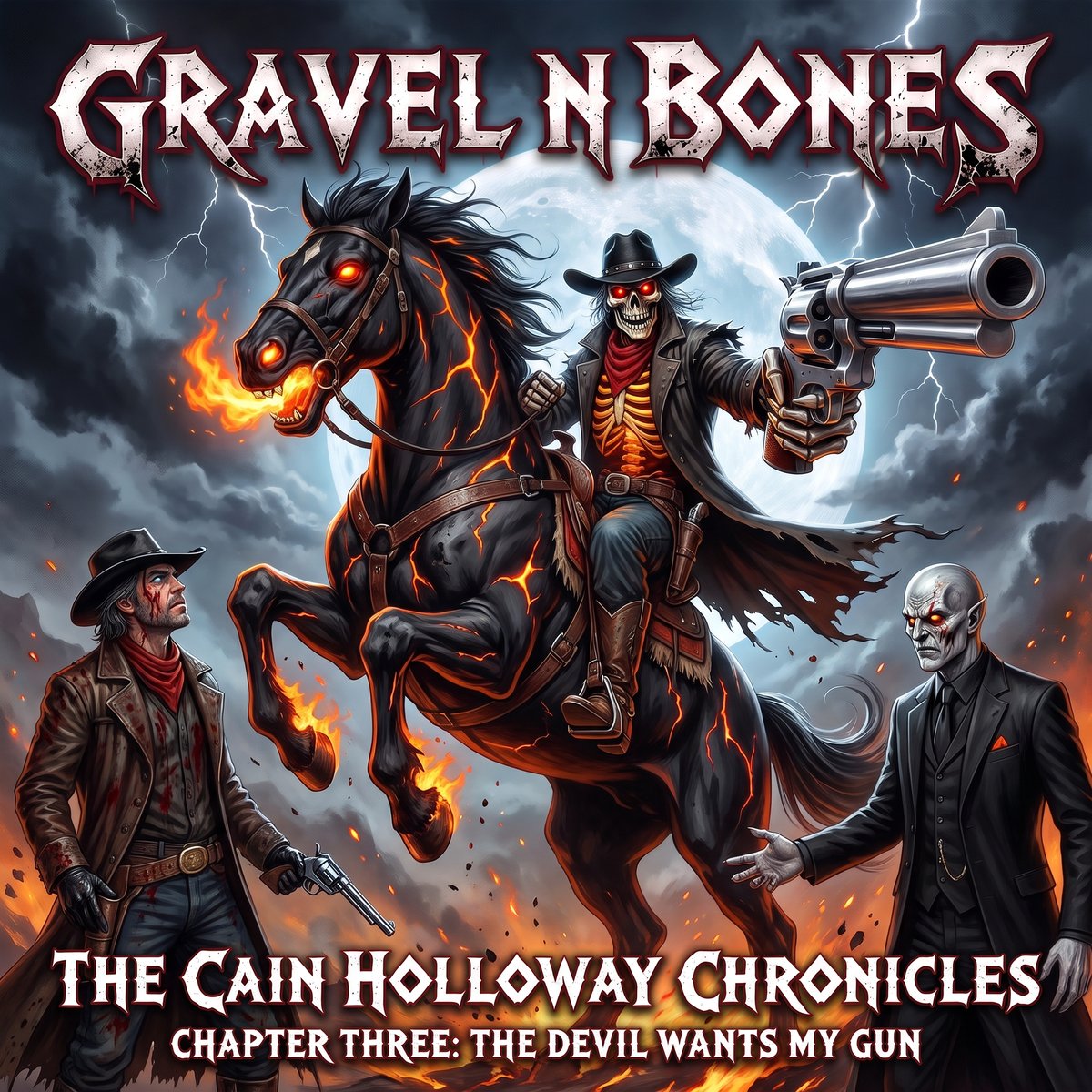
The Devil Wants My Gun. The most relentless chapter of the story yet. Ten new tracks. Out now.
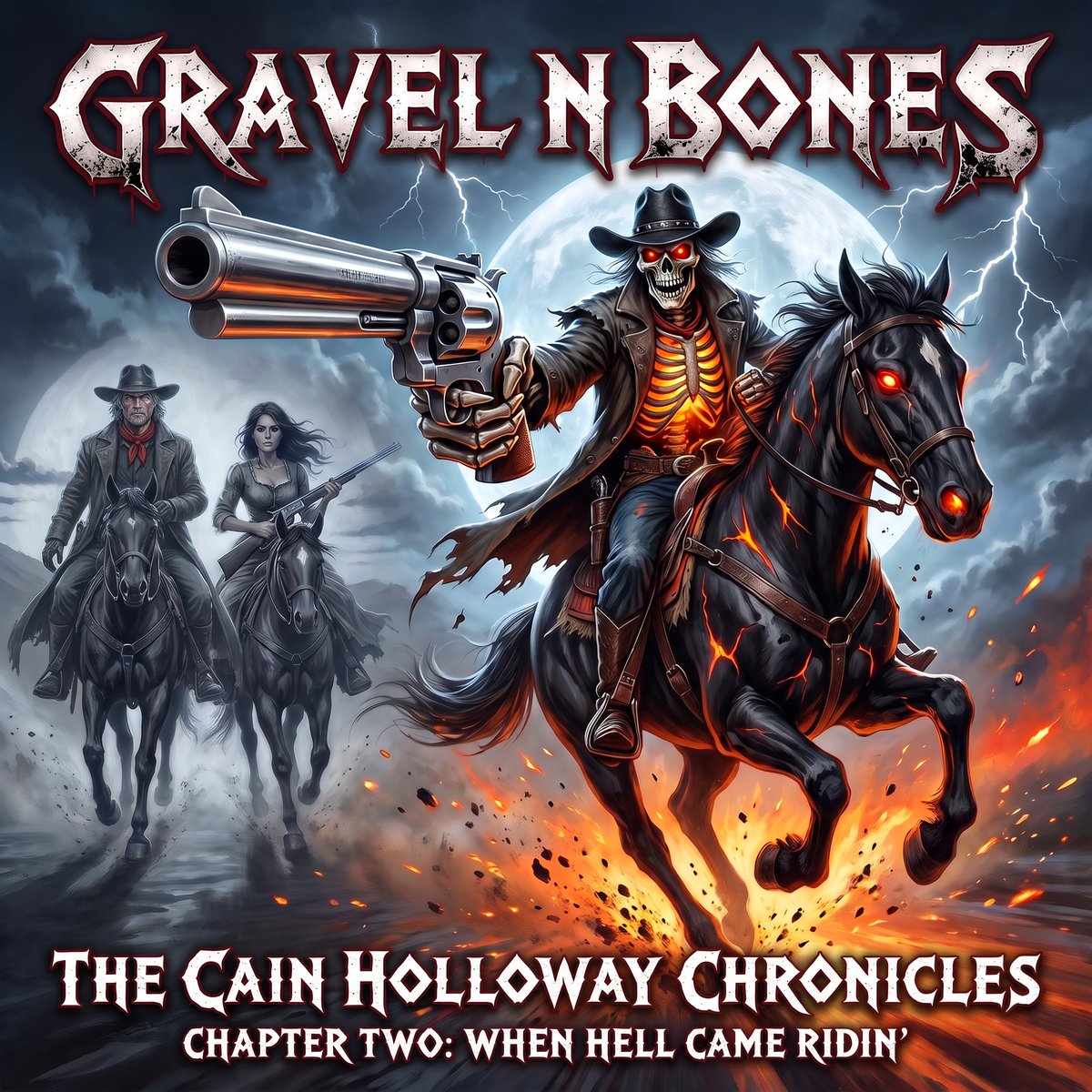
When Hell Came Ridin’. The Rider is back. Ten new tracks. Out now.
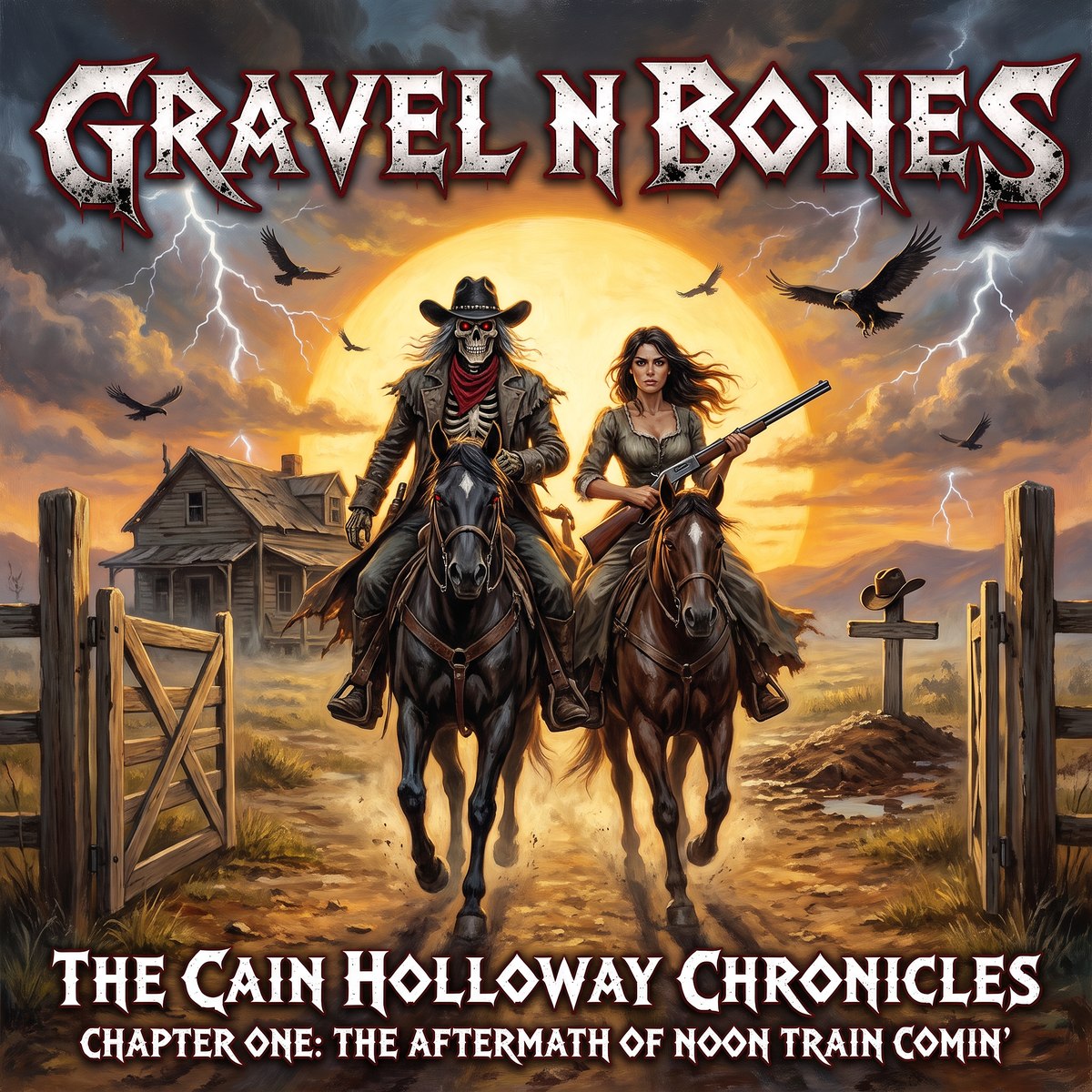
The Aftermath of Noon Train Comin’. The Chronicles begin where Preacher’s Got a Gun went quiet. Ten new tracks. Out now.
New to Cain Holloway or need to get caught up before it drops? Listen to The Last Ride of Cain Holloway and the single Noon Train Comin’. This chapter picks up where they leave off.
Chapter One: The Aftermath of Noon Train Comin’ is the direct sequel to The Last Ride of Cain Holloway, and it answers a question fans have carried since the single dropped. In Noon Train Comin’, a hunted gunman gets a warning wire: six men are coming for his head on the noon train, and the wire came from an old friend. The single never says who sent it. This album does. Cain Holloway sent that wire. Five years into hiding behind the pulpit in Grace, one unsigned telegram drags his buried past into his church, brings a company detective to his door, and puts him back on the road to the wife he left behind. It ends with a trick at the edge of an empty hole, a debt paid in lead, and two riders leaving Texas together while Grace goes on telling the story wrong.
Six hired guns pass through Grace on their way west and don’t stay long - just long enough for a man from Cain’s church to overhear the plan: they’re riding to kill a man. The name is Amos Pike, and Cain’s blood runs cold, because ten years back their guns were bought and sold together, paid in silver, with a lot of men left dead in Texas behind them. Cain owes Pike nothing and would let it be, but six paid guns on one man gets to him. He walks down to the wire before morning and sends a warning west, never signing his name. Weeks pass with nothing coming back, and Cain figures Amos Pike for dead - until word comes into Grace down the track: six men stepped off that noon train and not one rode back. One man walked away when the smoke went clear. Amos Pike is alive, and he’s riding here.
Pike rides into Grace and goes straight to the wire office, looking to learn who sent the warning that saved his life. The wire man points him to the preacher from the church around the way. He walks in without removing his hat, sits down in a pew, looks around, and laughs out loud when he sees the face behind the pulpit: “Cain Holloway, preachin’ in Grace.” He tells Cain what the wire bought - six men off the noon train, all of them dead, and he never asked a name. Then he asks the question straight: he figured Cain would let him die, so why the warning? Cain gives him the truth. He planned that job in Denver, and if Pike is on the company’s list, Cain’s life is in danger too. Pike confirms the worst of it: the heist Cain planned and the gold they split was company money, and the company won’t quit. They’ll send more men. They always do. Two killers looking at the same end - and Cain has no choice but to help his old friend.
They brace for gunmen - could be six, could be ten - keeping their guns loaded and close, sleeping in shifts and watching the land. What comes instead is one man, alone, riding up to the church door and stepping down easy like he’s been there before. Amos pulls on him and the man doesn’t flinch. His name is Harlan Doss, sent by the company to settle a loss, and his shield comes out before anything else: kill him here if you like, but his men kill Cain’s wife in Texas tonight. He’s been hunting since the Denver job - he always had Cain’s name, never his town, and following Pike led him right to it. The demand is simple: every dollar of the payroll back, or Cain and Pike and Lila all pay. He gives them time to decide, tips his hat, and rides out. Then Amos says the thing that turns the demand into a death sentence: that gold was spent a long time ago. They can’t pay him, can’t kill him, can’t even ride out of town - every way Cain turns it, it ends with Lila dead, her life in a stranger’s hand.
Just before dawn the one way out comes to Cain: Doss still thinks the gold is real, and as long as he does, they’ve got room to deal. Cain finds Doss in town at first light and sells him the lie - the gold’s still buried on her daddy’s land, ride with us and it’s back in your hand. Doss takes the deal and keeps the knife: his men stay posted on Lila, and if Cain crosses him once, it costs her life. Cain stands one last time at the church door, leaves the Book to gather dust, and keeps the Colt - the one thing he trusts. They ride west with the enemy at their side, playing every mile like there’s nothing to hide, while five years of unsaid words get closer with every fence post. One night on the trail Amos leans in low and asks what the play is when there’s nothing to show. Cain’s answer is the whole plan: when that hole comes up bare, he’ll be close enough to get her out of there. They cross onto her daddy’s land with smoke drifting from her chimney - Cain riding back to the only home he knows.
They come up the road to Lila’s ranch and find Doss’s crew holding it - men posted all over the place, and no sign of the woman Cain came for. Doss gets down off his horse and says show me where. Cain counts his men and every rifle there, then says it plain: he doesn’t care if it costs his life, nobody digs till he sees his wife. Doss thinks it over, answers with a smile, and has her brought out - it costs him nothing he can see. Lila pulls her arm free of the man walking her, and the first thing she does is look straight at Cain. She doesn’t cry and she doesn’t shout; one look says she’s figured it out. Five years of nights he saw her face, and now she’s twenty steps away through nothin’ but guns. She holds his eyes in front of everybody and doesn’t look down - Lila saying she’ll stand her ground. Then they walk her back inside, and Doss sets the terms: enjoy the night, don’t run. First light, we dig.
They put Cain in the house and bar the door, and the five years of words he carried west slip away the moment he takes his hat off. Lila speaks first, her voice low: five years, Cain, and nothing to show. No letter came when her daddy died - she dug his grave with no one at her side. Cain doesn’t defend it: there’s no fixing five years. He stayed gone to keep her in the clear, and trouble found her all the same - every gun out there came for his name. Then the turn comes, and it’s hers: she followed the stories, heard them all - the preacher back east with the gun in his hand - and she looked for him in every tale that drifted down the trail. He takes one step; she takes the rest. All them years end against his chest, and neither of them cries - too much living has run them dry. They talk the lamp low while a guard walks past the door every hour. Five years he stayed gone on his own; it took their guns to bring him home. She drifts off, and he sits in the dark and lets her sleep. There’s one more thing he still has to say - but not right away.
He wakes her in the dead of night, and she reads his face before he says a word: “Cain, I know that look too well. You got somethin’ bad to tell.” He gives her all of it straight - the lie he sold to get through her gate, and the truth that there’s no gold in that ground outside. When the hole comes up empty, everybody dies - and he means it as a plan, not a fear: come morning, when they see that empty hole, he’ll already have his gun in hand, and he aims to kill every man on this land. Her answer is her own: she kneels, pulls a floorboard free, and brings out her daddy’s pistol, hidden where the company’s men couldn’t see when they took every gun in sight. Come the morning, she’s in this fight. Five years ago he rode away and she stood in the door with nothing to say - whatever comes with the morning sky, this time there’s no more goodbyes. Live or die. The stars burn out one by one while Cain checks his gun and Lila watches the sky turn gray. First light comes crawling across the floor, a fist pounds the front door, and Doss calls out that it’s time to pay. Cain steps out first and leads the way.
They pull Amos out of the barn at dawn, toss down two shovels, and wave them on. Cain picks a spot like he knows it well and starts throwing dirt with a lie to sell. The hole gets deeper, the sun climbs high, and Doss stands over them with greed in his eye while his men get easy, leaning on their guns. Then Cain stops his shovel and lets it ring - looks up at Doss and doesn’t say a thing. Doss hollers gold and jumps in that hole, ten years of waiting finally taking its toll. Cain grabs his collar before his boots hit ground, pulls his hidden pistol, spins him around, and jams the barrel up under his chin. Every man in the yard freezes. Lila pulls her pistol before they can turn her way - nobody’s taking her hostage that day - and Amos swings his shovel, drops the nearest man, and comes up with that rifle ready in hand. Cain calls it loud so every man can hear: anybody moves, and Doss dies right here. Doss’s voice comes out barely a sound: “Easy boys, put your rifles down.” He’d read Cain’s file. He knew that trigger would get pulled fast. One by one the rifles hit the ground, hands in the air, not a single sound - every gun they had lying in the dirt. Then Cain and Amos went back to work.
Cain made a promise the night before - everybody dies, that’s what he swore - and he keeps it with Doss pulled close as his shield while the yard turns into a killing field. Some grab for the rifles they laid down and never make it. Amos works his taken rifle left and right; Lila stands her ground out in the yard, pistol up, gun smoke drifting over the sand, dead men falling across her land. The company came to collect what’s owed - and today they get paid in full. Not with gold, but paid in full. In the middle of it, one man who slipped back during the fight gets Lila lined up dead in his sights. Amos sees it and doesn’t think twice. He jumps in front and takes the bullet meant for her. Cain puts three in the shooter and sends him with the rest, and then the guns go quiet - the last of Doss’s men is down. They kneel with Amos in the sand, Lila holding his hand, and he looks up at Cain with that same old grin: “The wire’s paid. We’re square again.” He looks around at the work they’ve done - every company man dead in the sun - closes his eyes, and lets go. That leaves Doss, the last one drawing breath, on his knees with nothing left. Cain says it cold: ten years you hunted me down. Well, you found me. How you like me now. Doss opens his mouth with something to say, and Cain pulls the trigger and walks away.
They dig one more grave before the day is through, for the last old friend Cain ever knew - and the preacher says the words he’s said over other men for five years, meaning them for the first time. The company’s dead get left for the buzzards. Lila asks if it’s over, and Cain tells her the truth: there’ll be more to come. There’ll be more men on another train, another Doss with another name. He tells her she could stay - keep her daddy’s land, free and clear. She looks at him like he’s lost his mind: “You ain’t leavin’ me behind.” They pack light and saddle before dawn, and nobody watches from the doorway this time - both of them leaving it all behind. No house this time, no peg by the door, no hiding what he is anymore. She rides with a killer and she knows it plain; she knew what he was and came just the same. If the company wants them, let ’em come. And back in Grace they tell it still, about the preacher man who used to kill. They say Lila’s in Texas, he never saw her face - and some stories are better left in place.
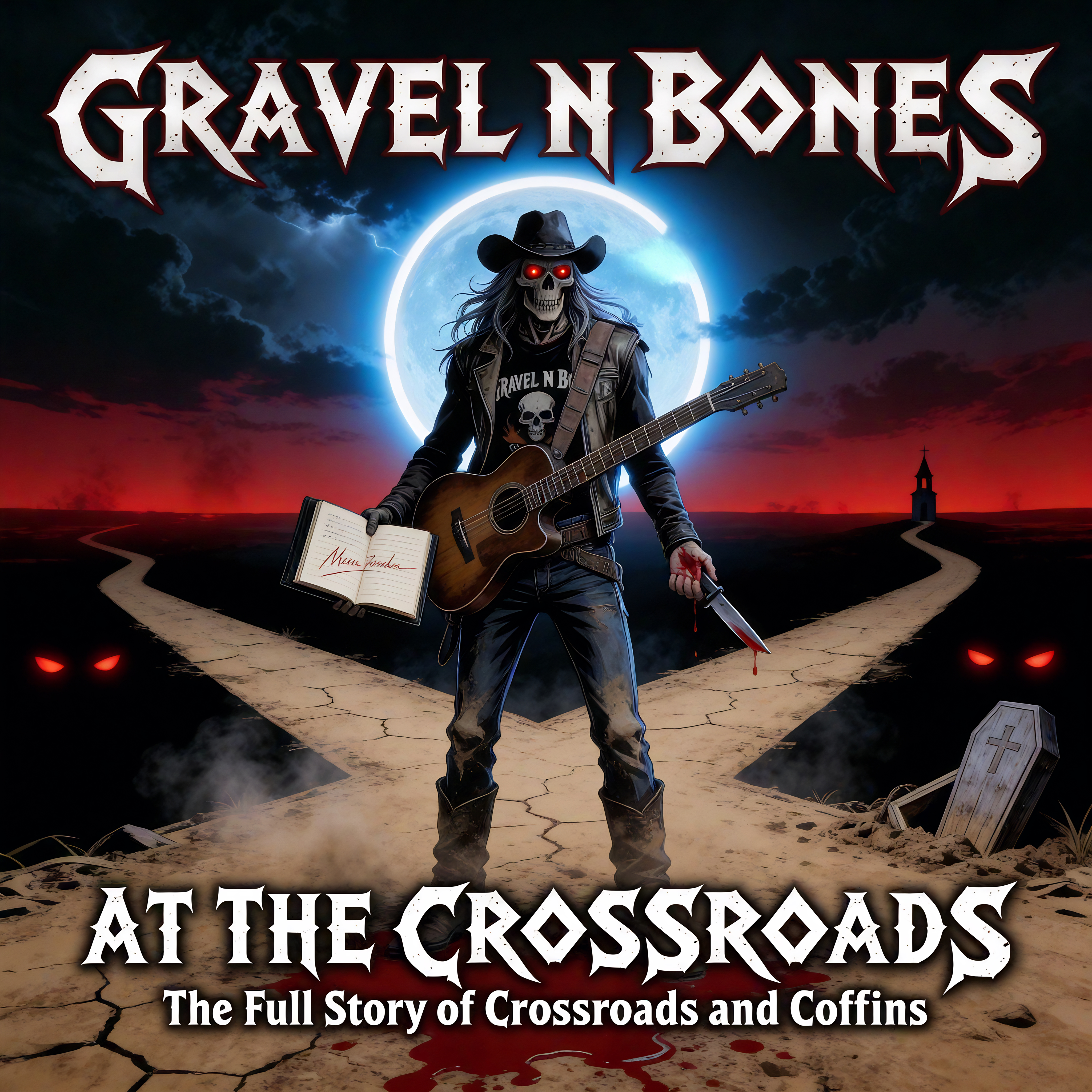
The Full Story of Crossroads and Coffins. A modern crossroads case - same Devil, same play, one hundred years after the frontier. Ten tracks tracing an unnamed protagonist from the hunger that made him, through the blood-signed deal on Highway 61, through ten years of stadium fame he couldn’t hold onto, to the debt collected at a preacher’s pulpit in a town called Blackwater under a blood-red sky.
Physical CDs and vinyl aren’t being pressed at this time. If you’d rather own the music than just stream it, every album is available as high-quality MP3 downloads on Amazon.
Buy MP3 Downloads on AmazonAt the Crossroads is the full story behind the Graveyard Psalms track “Crossroads and Coffins.” It’s a modern crossroads case - same Devil, same play, one hundred years after the frontier. An unnamed poor kid from the South grinds run-down honky tonks for years, finally gets fed up, and hunts down an old bluesman who once told him about the deal. He signs in blood on Highway 61, lives ten years of stadium fame, then walks off the tour to beg for a pardon. The Devil refuses - and reveals himself as the same old man from the honky tonk. With nowhere left to go, he runs to a town called Blackwater and takes up a preacher’s collar for five years, hoping God’s forgiveness might outbid the ledger. In the same town where the 1880s crossroads preacher hid and burned, a century later, history repeats. The Rider - running the Blackwater Devils MC in Jesse’s body - comes to collect.
He was born dirt-poor in the late-1970s South, a farmer’s kid with hand-me-downs and beans on the table and a father who broke his back keeping them fed. By twelve he had a pawn-shop guitar and taught himself off the radio. People laughed when he said he’d get out. Big stars on the TV had come from where he came from, ate what he ate, and made it anyway - and that’s what sat wrong with him. He’d do anything to be one of them. His mother caught him at the door the night he left and told him wanting it that bad would cost more than he knew. He kissed her forehead, took the guitar off the wall, and rolled past the county line at dawn with forty dollars in his jeans and a six-string on the seat, sensing something was already waiting down the road.
No label would sign him. He grinded the run-down honky tonks town to town, singing to near-empty rooms like somebody cared. One night the only man who stayed till closing was an old itinerant bluesman. He told the kid he had the ache but talent alone doesn’t sell - and then told him about the crossroads. Stand at midnight where two roads cross, wait for the Devil, sign your name in blood, and the fame starts today. He owns your soul when you die, but you get everything you want in the meantime. And he warned: the Devil always comes back to collect - you won’t grow old. The kid heard him out, laughed him off as a drunk with a tale, packed up, and hit the road. Seed planted and forgotten.
Five more years on no-name stages, playing for beer and change. He was NOT broken and NOT quitting - he was fed up. One night on the radio he heard a hack half his talent selling out venues, and something snapped. A label man caught his set, gave him a card, took his call for a week straight and never picked up. Driving home broke at dawn, the old bluesman’s voice from years back came back to him. What did he have to lose? He decided to find the old man again. But he’d brushed him off and never asked where the crossroads was. He’d have to hunt him down.
He headed south into the Mississippi Delta and worked bar to bar looking for the old man. Nobody knew him, nobody talked. A week in the Delta, every door locked. About to give up, he walked into one last joint and the old man was already sitting there, grinning, like he knew the kid was coming. “Heard you was lookin’.” The directions were plain: Highway 61, where two roads cross, midnight, stand and wait, the Devil comes, and you’ll sign your fate. A chill ran through the kid; something in the old man’s eyes said run. But the hunger won. He shoved it down and did like he was told. Midnight came. He drove to the crossroad, killed his headlights, stepped out, and waited to be found.
Two red eyes opened in the dark. A shadow stepped out. The cold rolled in. A deep voice growled: “Let the deal begin.” The Devil held out a book bound in black - sign in blood, no giving it back, the fame, the gold, the name in exchange for his soul, claimed when he dies. The kid cut his hand and signed his name in blood on the page. The page burned red. The book slammed shut. “The deal is cut.” Then the Devil was gone. The kid looked down and the cut on his hand had already healed. That’s when he knew the deal was real. One cold thought stood in his chest - this ain’t right - but he shoved it off, climbed back in the truck as the sky turned gray, and drove away. The same road, but everything had changed. The world was about to know his name.
The phone rang the very next morning - a big label out of the blue. He signed. Cut his first record in a Nashville room and it shot up the charts and wouldn’t slow down - the number one he demanded from a bar stage years ago, playing in every town. The label sent him out headlining and every arena sold out before the tour began. Fifty thousand a night. More money in one show than his daddy saw in a year. He bought his mother a mansion, drove a Cadillac, hung gold records wall to wall. The feed store boys who once asked where he thought he’d go now saw him on every talk show; the label man who slammed the door on him now worked for him down the hall. It all came so fast. And the album’s closing line is the first crack in the confidence: he knows the deal’s terms and he knows the clock exists, and now, standing on top of it all, he’s wondering how long it will last.
Ten years since the deal. Still on top, fifty thousand a night, but hollow. The crowd screamed a name that wasn’t his. The song he’d bled to write meant nothing in his mouth. The reflection in the mirror was a famous stranger with a name he didn’t own. Nights he lay awake counting days - tortured most by the open clock, because nobody had ever told him how long he had. The old bluesman’s warning from the honky tonk had become his own dying breath: fame and gold in hand with nothing left to gain, and everything he was was the price he’d paid. He made his decision in the bridge - his time felt close, he’d drive back south to the fork on 61 and beg the Devil for a pardon or a way out. He walked out of a sold-out show mid-tour, left the money and the mansion and his name in lights, and pointed the truck south.
He drove all night to the crossroad on 61 and stood in the same spot he’d signed. Midnight came. The cold rolled in - the Devil’s arrival sign - but what walked out of the dark wasn’t the shadow-with-red-eyes he remembered. It was the old man from the honky tonk, grinning. That was the second his blood ran cold. It had been him all along - every step, every place. He dropped to his knees in the road and begged: take it back, give me back my soul. The Devil laughed long and loud. “A deal’s a deal, boy. You got what you chose. I warned you that night. You knew what you owed. It’s signed there in blood and that book stays closed.” Then gone, leaving him alone with the fame he couldn’t give back and a debt still due. Climbing back in the truck, his headlights hit a sign at the roadside: BLACKWATER, TEN MILES. And a last idea formed - maybe God could do what the Devil wouldn’t. Maybe the Lord’s forgiveness could outbid the ledger. He turned toward the town.
He rolled into Blackwater with nothing but his truck and no name. The old church on the hill had stood empty for years. He picked up the Book and answered on his own, unordained, and preached for five years - fed the poor, prayed for the sick, buried the dead - hoping God was watching every prayer. In the same town where the 1880s crossroads preacher had hidden and burned, a century later, a second damned preacher stood at the same pulpit hoping the same trick would work. It didn’t. Old folks in that town told tales after dark about the Blackwater Devils Motorcycle Club and the thing that led it - that when the sky turned blood red, somebody was marked for death. Then one Sunday evening the sky turned blood red. Engines rumbled from way down the road. A dozen black Harleys pulled up to his church and cut their motors dead still. The stories were real. The Rider walked to his doorway with the fire in his chest. Our preacher took the 1880s preacher’s stance - defiant but knowing, tired and done, ready. He never begged. He raised his eyes and looked the Rider in the face and said his own last words: a deal’s a deal in the end and the Devil got my soul. The fire took him where he stood.
The folklore cap. The story is done; now it’s legend. Down in the Delta, in a highway bar where the whiskey’s stale, some old timer leans in when the night gets slow and tells the tale to whoever will listen. This is the “Preacher’s Got a Gun: Deux” treatment - the Graveyard Psalms seed track’s verses and all three canonical choruses kept as-written, bookended with a new opener that stages the folklore-compression mechanic live, and a closer that lets the legend fork. Some folks say the story ended at the crossroads with a bullet on the ledger - the seed’s version. Some tell of a preacher in a swamp town church that burned under a blood red sky - the album’s true ending. The stories don’t agree on where he fell, but every one of them ends with his soul in Hell. The Devil’s still dealing. Maybe next time, it’s you.
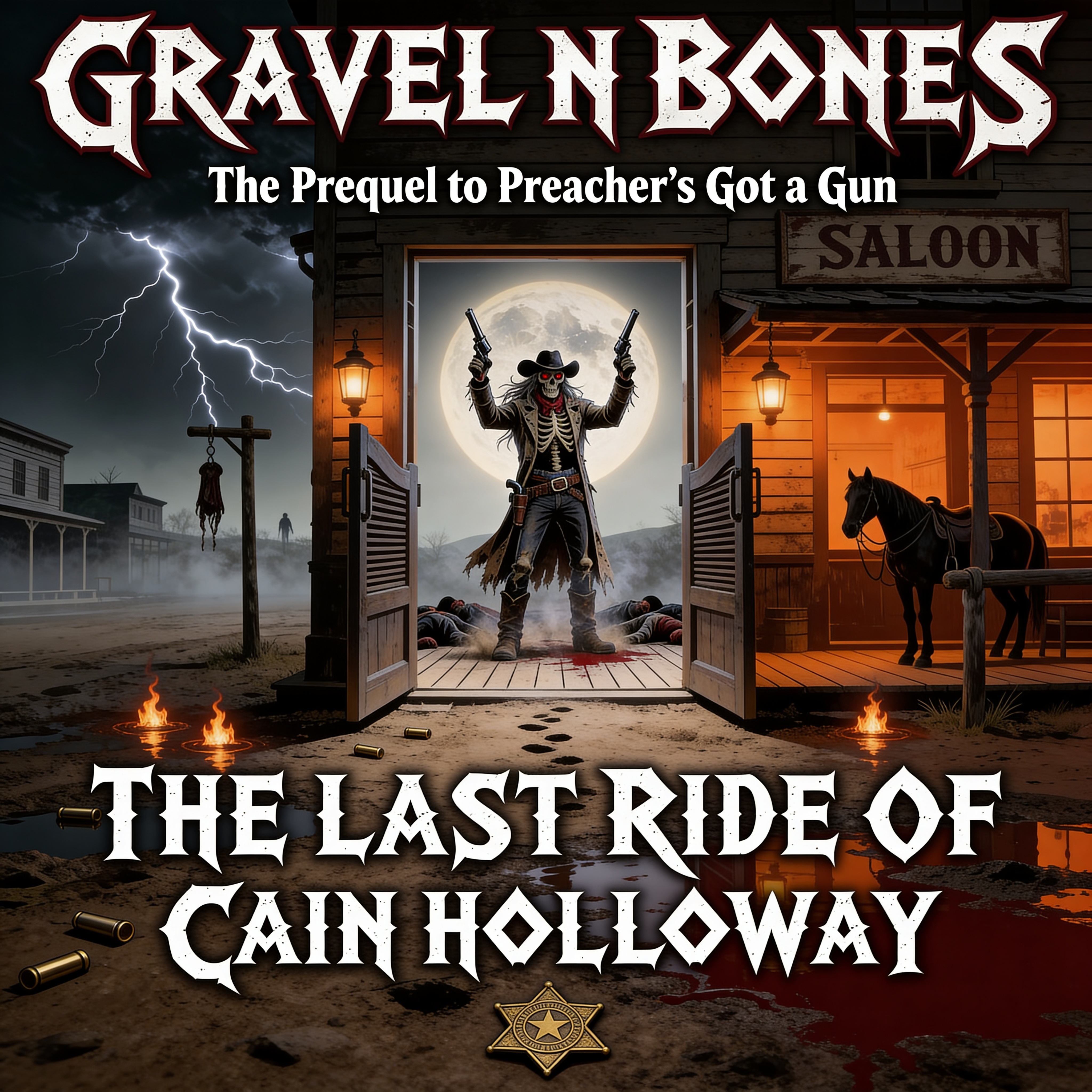
The prequel to Preacher's Got a Gun. Long before he ever stood at the pulpit in a town called Grace, Cain Holloway was a killer for hire in 1880s Texas. This 9-track concept album tells the story of who he was, what he lost, and the bloody road that turned him into the Preacher.
The Last Ride of Cain Holloway is the prequel to Preacher's Got a Gun. It tells the full story of who the Preacher was before he walked into the town of Grace. Cain Holloway was a killer for hire in 1880s Texas, a man who fed half the state to mesquite and bone before a woman named Lila pulled him back from the edge. But peace doesn't hold forever. When a widow named Mary Hardy rides three days to his door with the story of her ten-year-old son murdered by a corrupt sheriff's family, Cain takes the Colt back down off the peg and rides one last time. What follows is a bloody descent that costs him everything - his wife, his only friend, and any chance of going home - and ends in a town called Grace where a different kind of man stands up at the pulpit.
This album is dedicated to Mark "Spooner" Eastwood, whose message inspired the push to finish this story.
Cain introduces himself. A killer with a price on his head, riding the Panhandle and the Brazos with names in his saddlebag and dried blood on his knife. He took silver from men in lamplit rooms and sent sinners to unmarked graves. He never asked Heaven to balance his score and quit believing in much of anything around the third man dead. But even then there were nights his horse threw back its ears, like the dark itself carried bootsteps near - like the devil was already keeping a tab. This is the man Lila will meet. This is what she will marry.
Lila's father hired Cain to kill the man cutting his cattle in half. Cain rode up the road expecting another job, but Lila walked out into the yard alone and asked him to spare the man and leave the blood off their land. He did. She married him. She made him eat at the kitchen table instead of off his knife in the dark, hung his gun belt on a peg by the door, and prayed over him while he slept. "You ain't just what you've done," she told him - and those words got in his chest and never went away. He knew men like him don't keep good wood walls and a woman asleep, but for a while, he had both.
A widow rides up to Cain's porch alone at dusk - Mary Hardy from Black Hollow. Her ten-year-old boy Daniel was killed by the corrupt sheriff's son, who emptied all six rounds into the child for trying to stop the man from beating his mother. The sheriff wears the badge that protects his son. No judge will ever convict. Mary buried Daniel by the creek with her own two hands. She offers Cain every dollar she has. Cain sits on the porch step, head bent, Lila watching silent from the doorway, and turns the story over in his head. He knows the answer coming isn't going to come up fair.
Cain comes into the kitchen where the lamp burns low. Lila looks at him once and says, "You're fixin' to go." She tells him what they both already know: if he kills the sheriff and his son, he can never come home. The Rangers will hunt him. They won't grow old together. She won't follow him into a hunted life. Cain says the sheriff and his son will keep on killing if no one stops them - that he has to pass the verdict the law won't. Lila says she knew this day would come the day she married him. They don't speak again that night. He watches her sleep. At dawn he takes the Colt back down off the peg and buckles on the belt. The last goodbye is silent.
Cain rides three days west to find his old partner Tucker Vance - the killer and thief he used to ride with before either of them tried to settle down. Tucker's wife is long dead, buried in a small fenced grave at the edge of his ranch. He meets Cain at the gate and tells him he's done with the old life. Then Cain says one thing: a widow's ten-year-old son was killed by the sheriff's son, and the badge protects the killer. Tucker walks alone out to his wife's grave, stays there with his hat in his hands, and when he comes back his answer is in his eyes. He shoulders his Winchester and they ride for Black Hollow with no plan of coming back.
The road into Black Hollow runs through a narrow pass with rock walls on both sides. Cain and Tucker ride in thinking they're the hunters. They have no idea Crane has had spies watching Mary Hardy for weeks - the spies saw her at Cain's porch and rode the news back. Crane had time to plan an ambush. Six men open fire from the rocks above. Cain's horse goes down with a bullet through the neck. Cain and Tucker take cover, return fire, and kill four of Crane's men. The other two ride hard back to town. Cain takes a round in the side. Tucker's leg gets grazed. They limp to an old cabin by the river to lay up and heal.
A week passes at the cabin. Food runs low. Tucker can't go to Black Hollow - he'd be recognized - so he rides to Mary Hardy's place for supplies. On the way back, Crane's men catch him on the road. Tucker kills two before they take him down. They tie him to a horse and bring him to Black Hollow, where Crane takes out his bullwhip and tries to break him for Cain's location. Tucker holds his silence. He never says a word. Crane whips him until he dies right where he was bound. They hang his body at the entrance to town as a warning. Mary hears the talk, rides in to see, and confirms it's Tucker. She rides out to the cabin at the break of dawn to tell Cain. Tucker never gave him up.
Cain heals enough to ride. He says goodbye to Mary and rides toward Black Hollow with vengeance on his mind. He passes Tucker's body at the entrance post and keeps moving - no time to stop, no time to bury. He walks into the saloon where Crane and his entire posse are gathered, drawing up plans to hunt Cain down. Shotgun in one hand, pistol in the other. The first shot takes Crane between the eyes. The second takes his son. The posse pulls their pistols too late. When the smoke clears, Cain tells the few still alive to run and hide. He drinks a whiskey alone at the bar with bodies on the floor. Then he walks into the street and yells his warning loud: any man he ever sees again dies, and so do their kin and their houses. Black Hollow watches him leave. No one makes a sound.
Cain rode east from Texas with the blood still on his hands. He buried what he was at a creek in unmarked sand. He came to a town called Grace and never rode no more - took the pulpit and the Bible, and kept the Colt he always wore. This is the reimagined version of the original Preacher's Got a Gun, framed by Cain's full story. Listeners hear the familiar lyrics - the Sunday morning quiet in Grace, Billy Walker face-down on sacred ground, the sheriff warning the Preacher he's crossing a line - but now they know exactly what past he doesn't speak of. The album closes with the Preacher's voice: Lila lives in Texas, but he never saw her face again. Tucker died at Black Hollow - his only friend. The men he killed come back to him when sleep is hard to find. The Lord can judge him later. For now, His work is the Preacher's.
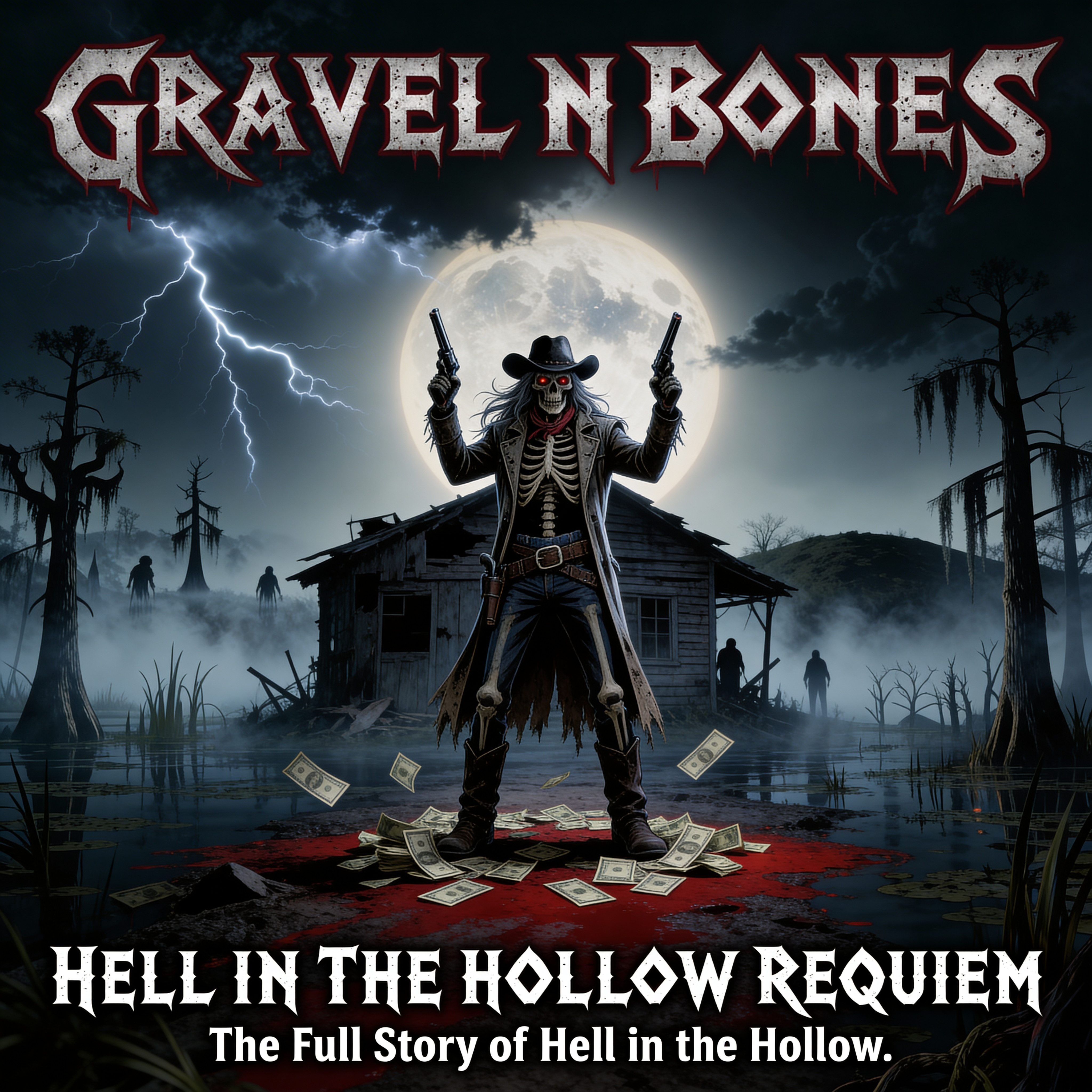
The full expansion of the Graveyard Psalms track “Hell in the Hollow.” A contained tragedy of brotherhood and betrayal set in Blackwater Hollow long before the Devils rode there. Two men born of the same dirt, a bank job that should’ve been quick and clean, and a trap that left one of them bleeding in a shack with the law closing in.
Hell in the Hollow: Requiem is the full expansion of the Graveyard Psalms track “Hell in the Hollow.” It tells the complete story of the man behind the legend - the betrayal, the trap, the deputy shootout in the shack, the reckoning that followed. Two men were born of the same dirt and rode the same hard road, brothers by bond if not by blood. But when one of them got caught with a trunk full of meth and the law offered him a way out, he sold his closest friend with an elaborate trap that took two stages to spring. What follows is a tragedy in eight tracks - bank robbery, engineered bar fight, planted money, deputy shootout, slow knife revenge, and a final stand on the road with the law closing in. The shack where the deputies died still stands today in Blackwater Hollow. The stories left behind still whisper the blame.
The narrator and his closest friend grew up on the same side of the same hard town - same dirt road, same drunken fathers, same code. They shared a cell once and never spoke a word, because they weren’t the snitching kind. They fought for each other before they could shave and swore they’d be side by side in their graves. That kind of brother don’t come twice in a life. The narrator would have walked into hell before he thought twice about it. The bridge hints at what’s coming: should’ve seen it - maybe the signs were there. But you don’t look for snakes in the only good place left. When you’re out of road and out of time, you ride to your brother. You’re partner in crime.
Friday morning before the town stirred. Two men waiting without saying a word. They walked in behind the bank clerk before he could turn, guns drawn, money to earn. Pistol-whipped the manager, made him open the safe. Walked out clean. The whole job took minutes. They couldn’t ride around with that kind of cash, so the brother said he knew a place he could stash it fast. The narrator handed the bag over without a second thought - the kind of trust a lifetime had bought. They went their separate ways to let the heat die down. The narrator kept his head down and stayed out of sight, trusting his brother to do what was right. The job was done quick and clean. What was to come couldn’t have been seen.
The narrator walked into a bar just to have a drink. Three men at a table on the other side watched him settle in with something in their eyes. He minded his business, nursed his glass. Then the biggest one pushed back his chair, walked up slow, leaned in on the bar, and asked where the narrator’s “fine sister” was - he’d like a taste. The narrator tried to let it go. The big one laughed and the other two rose. The narrator warned them once. The big one reached. Three shots, three men down. The bar went silent. The narrator stood and stared at what he’d done. He didn’t want trouble. He just wanted a drink. Now three men were dead by the morning light and the law was on the way.
The narrator’s partner in crime was the only call. He knocked on the door with his back to the wall and told him straight what went down. The brother let him in, poured him a shot, listened to every word, and said don’t worry - he knew a way. He told him about a shack deep in the hollow where nobody goes, where the dark water flows. Safe from the law and safe from the hounds. He’d come for him when the heat died down. The narrator headed into the dark feeling safe for the first time. His partner had his back. Then he sat alone in the dark of the shack, felt along the wall, found a loose board, reached his hand in - and felt a bag. The bank money. Hidden in this shack. That’s when he knew something wasn’t right.
He sat in the dark with the cash in his hand, trying to figure out why it was there. Then he heard the hounds in the midnight air, saw the deputies’ lights, and a voice calling out: your boy turned you in. Come out with your hands high or you won’t be leaving. He wasn’t going out with his hands in the air. He grabbed his pistol, no time for prayers. Kicked the door and made his stand. Didn’t pray, just aimed and fired. Deputies falling, smoke filling the hollow, the night turning red. He kept shooting until they all fell dead. When the guns went quiet and the smoke cleared slow, he was the only man standing. And he knew exactly where to go. His brother betrayed him. By dawn the brother would answer for what he’d done.
He showed up at the brother’s door in the dead of night and kicked it wide open. The brother stumbled back, face white, thought the narrator was dead or locked up. The narrator pushed him inside, jammed the gun barrel into his guts, and told him to start talking. The brother dropped to his knees and confessed. He’d been busted with a trunk full of meth and couldn’t do the time. He cut a deal. He paid the three men in the bar to start the fight, knowing the narrator would come running to him when it went bad. He sent the narrator to the hollow where the money was stashed so the law would find him there with the stolen cash. Fear, not silver, made him choose. The narrator heard enough. He pulled his knife and gutted the brother slow, made him beg and scream. Born of the same dirt - that’s how a traitor dies. Then he walked out and left him where he lay.
He walked out slow with the blood still wet, cash in his hand, head full of death. Bank job behind him, barroom ghosts, dead deputies, a brother’s throat. All that blood for a bag of money. He told himself maybe he could stay ahead, outrun all the names of the dead. Find some place where the law don’t reach. But deep down he knew that was just a dream. You can run from men and you can hide from sight, but you can’t outrun what you did. He counted what he had and made his plan: get to the state line any way he could. Law or no law, he was gonna try. Live free on the run, or go down and die.
The law gained ground and time ran out. Closing in from every side, nowhere left to run, nowhere left to hide. He wouldn’t go down on his knees, wouldn’t give himself up. He lived by the gun and that was gonna be enough. Threw the money bag high into the air and came out shooting like he didn’t care. Took a few down before they got him good. Stood his ground like he always said he would. Lead tore through him but he wouldn’t fall. Kept shooting till he’d given all. Hit the ground with the money scattered around him. Three men dead in a bar one night. One more gone by the morning light. He put his life in a brother’s hand - and now his blood’s soaking through this land.
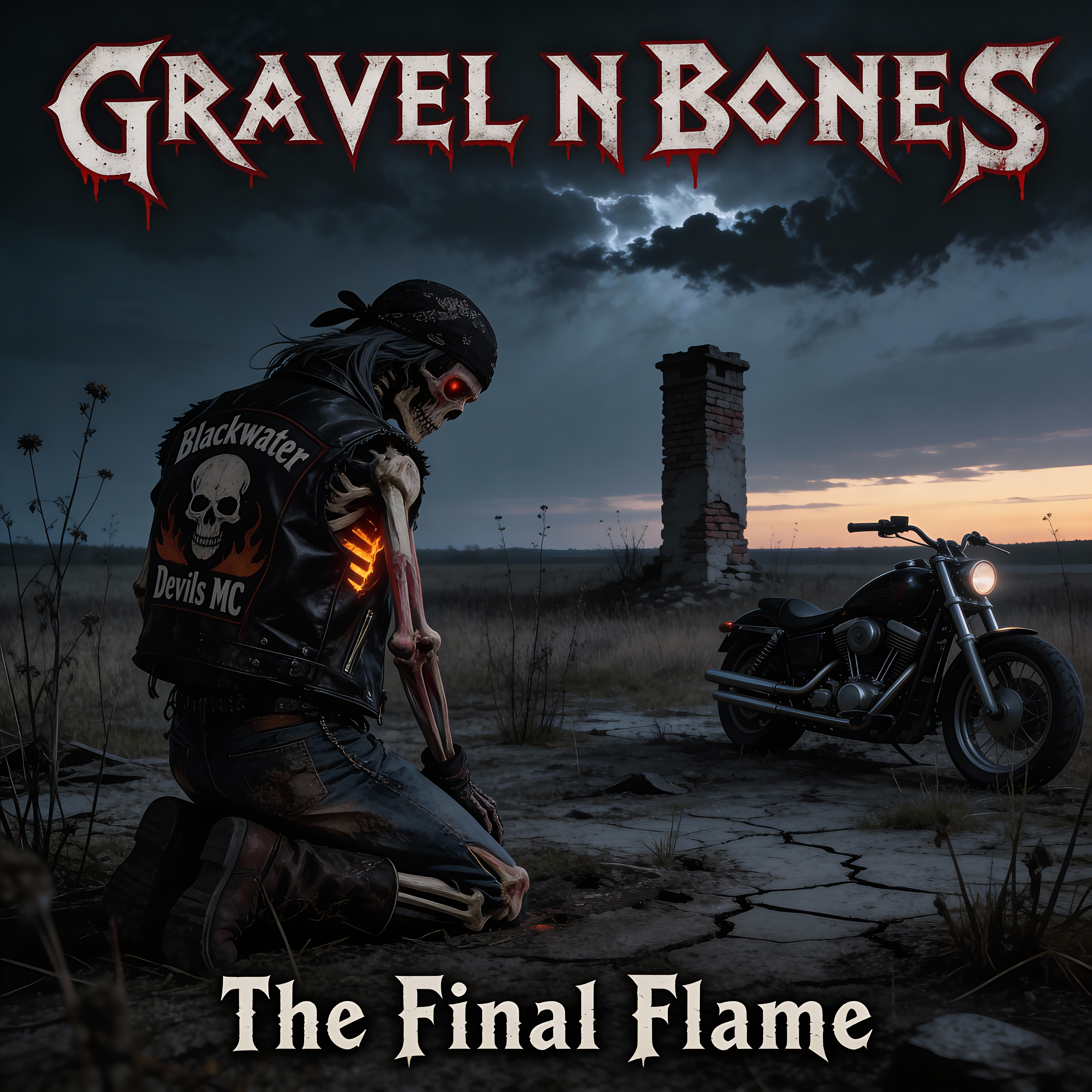
The epic conclusion to the Gravel N Bones saga. After decades leading the Blackwater Devils, the Rider uncovers a truth that shatters everything he believed about his curse, the Devil, and the fire that has burned in his chest for over a century.
The Final Flame brings the saga to its devastating conclusion. Twenty years have passed since the Rider seized control of the Blackwater Devils, and he has watched generation after generation of brothers grow old and die while he remains unchanged. But questions are surfacing - questions about the fire in his chest, about who really holds the chains, and about a past he thought was buried. When those questions draw the wrong kind of attention, the Rider is forced on a journey back through his own history. What waits for him at the end of that road? Only one way to find out.
Another year gone, another soul sent down. A hundred fifty years of blood and ash and screams, and the fire’s growing cold. The Rider is tired - tired of doing what he’s told, tired of being the Devil’s dog with no way to turn back. He’s forgotten his woman’s face, forgotten his baby’s dreams. Was the vengeance worth the cost? He got his revenge, but everything he loved is lost. The chains don’t break. Every soul he burns is another piece they take. He’s a prisoner in the flames where he fell, and there’s no way out.
The ritual never changes. Smoke, chrome, engines revving as they ride the fallen home. He’s dug the holes, lit the flames, outlived the faces but remembered the names. Forty years, forty minutes - it’s all the same to him now. Every brother he makes will eventually become another grave to visit, another bottle to empty. That’s the deal when you ride with the dead.
A young prospect wanted to prove his worth and followed the Rider out past the edge of earth. He saw something he wasn’t supposed to see - fire pouring out, a man screaming, sin being taken. The kid ran back fast, locked himself in like a frightened bird. The Rider could end it quick, keep the secret tight. But he’s tired of killing to stay out of sight. He kicks in the door, sits down, and says “Ask me anything.” What happens next changes everything.
Midnight at the clubhouse, drinking alone. The door swings open but there’s no bike outside. A stranger walks in like a ghost - no patch, no ink, no shadow on the floor. He speaks in riddles about chains that aren’t what they seem, about going back to where the fire took hold. “The truth ain’t what you’ve been told,” he says. Then he’s gone, leaving only smoke and a haunting phrase the Rider can’t shake.
The Devil got word he’s been asking around. His response comes on a black horse with black flame and eyes dead as coal - the Devil’s own dog, sent to put him in the ground. By the time the Rider hits the dirt outside, most of his brothers are already dead. Bodies scattered, blood and smoke and shells all around. Two cursed things trading blows that no man could feel, tearing through walls and steel. In the end, only one walks away - but not before learning something the Devil wanted kept buried.
For the first time in over a hundred years, the Rider returns to the farm. Nothing left standing but the chimney stone, weeds and dirt where they built their home. Standing where the fire took everything, something feels different. The flame in his chest burns strange. He can feel her reaching out, but he doesn’t know why. Fragments of visions, whispers on the wind. She’s trying to tell him something, but something’s blocking it. The answers aren’t here.
The canyon where the Black Hand made their final call. The shallow grave still marked with stone, a hundred fifty years of gravel and bone. The Rider stands where he bled out in the dirt and calls him out. “I’ve done your killing, I’ve done your time. Tonight your hold on me comes to an end.” The confrontation that follows shakes the canyon floor - but the Devil’s parting words shake the Rider even more.
The swamp has been waiting. Deep in Blackwater, someone has answers - answers about the fire, about the curse, about a hundred fifty years of lies. What the Rider learns here will shatter everything he thought he knew about who he is and why he burns. Some truths are harder to carry than any chain.
Armed with the truth, the Rider has one more ride to make. One more name. One more door to kick in. One more debt to settle that spans generations. The fire knows what needs to be done, and this time, there will be no mercy, no bargaining, no escape. Ashes to ashes. Dust to dust.
The ride back is quiet. The road is long. Something is changing with every mile. At the place where it all began, where the fire first took hold, the saga finally reaches its end. After a hundred fifty years of burning, what waits for the Rider when the final flame goes out? Some say on quiet nights out by that old farmland, you can still see something. But that’s a story you’ll have to hear for yourself.
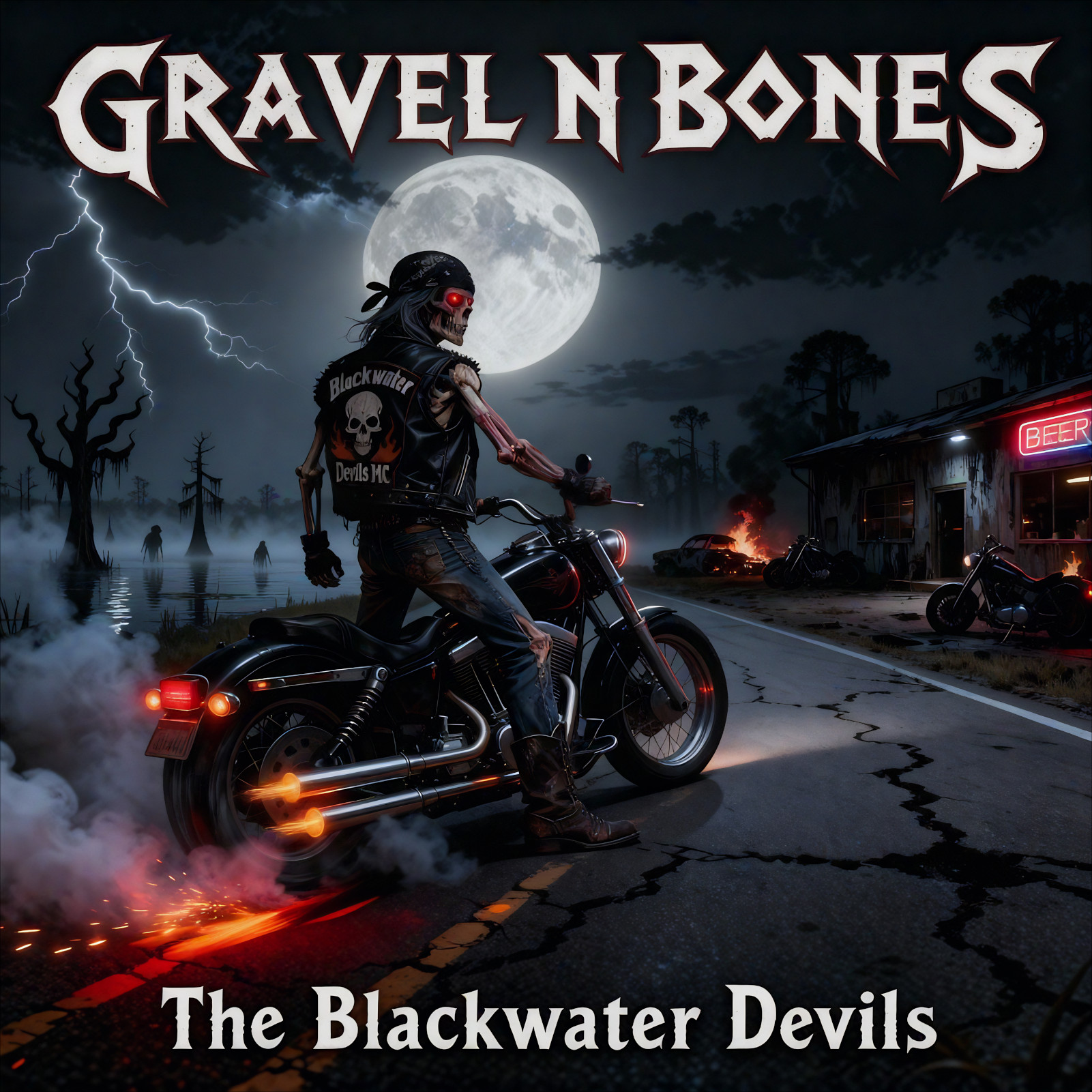
The Blackwater Devils drags the old curse of Blackwater Swamp into the 1970s, as the Blackwater Devils M.C. become the new vessel for Hell’s work on a Shovelhead Harley.
The Blackwater Devils drags the old curse of Blackwater Swamp into the 1970s. A century after the original demon rider was bound beneath the marsh, a new breed of outlaw rules the backroads: the Blackwater Devils M.C. When their paranoid, dope-soaked president orders a hit on his own enforcer, Jesse, the wounded biker wrecks and is thrown into Blackwater Swamp. The buried Hellfire that once rode a horse finds a new body to wear and rises again on a Shovelhead Harley. Across this album, the old Rider, mixed with his and Jesse’s memories, hunts down the men who betrayed him, seizes control of the club, cuts loose the law that thought it owned them, and is finally reminded that no patch, no territory, and no rank can free him from Hell’s work. By the end, the Blackwater Devils are no longer just a local outlaw crew; they are the roadbound weapon for a curse that has found a new age to burn.
The album opens on the swamp itself and the legend that never really died. Old-timers, barroom whispers, and backroad rumors all circle the same story: riders who vanish near Blackwater, ghost lights over the marsh, and a skeletal figure once seen on a burning horse. Generations have passed since anyone saw him, but the land still feels wrong, with trees leaning in, fog that does not burn off, and water that seems to remember bones. This track sets the stage: the Devil’s favorite hound is buried under the mud, but the curse is only sleeping, waiting for someone to stumble into its reach.
Here we meet the new world that has grown up around the old haunting. The Blackwater Devils M.C. run a shabby clubhouse on the edge of town, their bikes lined up against swamp fog and neon beer light. Jesse rides as Sergeant-at-Arms, reckless, strung out, and fearless in a way that makes even other Devils uneasy. The president, cooked on paranoia and pills, starts to see informants behind every argument and every bad run. This track paints the club’s daily grind of dope, bar fights, and backroad power, and shows the crack that will break everything: the president deciding Jesse looks more like a problem than a brother.
The tension snaps on a PCP run out on County Road 9. Under cover of night, the Devils ride out for a deal that is already poisoned from the inside, as the president has quietly called a vote, branded Jesse a rat without proof, and set the club up to take their own enforcer off the board. Shots erupt in the dark, and Jesse takes a round to the side. Mortally wounded but not dead yet, he manages to ride off. Bleeding out, tires skidding on gravel, he leaves a red trail toward Blackwater. The track ends with headlight and metal vanishing into the fog as his brothers ride away thinking the job is done.
Due to his weakened state from the gunshot, Jesse crashes and is thrown into Blackwater Swamp. In the black water and mud, the old curse finally finds a new shell. Jesse’s heart stops, lungs fill, and the weight of the swamp drags him down toward the same grave that holds the earlier Rider’s bones. But Hell has not forgotten its best weapon; the buried fire pushes up through water and rot, forcing itself into the broken body that landed in its grasp. Bones knit, ribs glow, and something wakes up that remembers Jesse’s life but is not Jesse anymore. By the end of the song, a figure claws its way out of the marsh, chest full of flames, drawn toward town on a road only Hell sees.
Crawling out of Blackwater, the thing in Jesse’s body carries more than Hellfire; it carries Jesse’s memories. In a rush of images, it sees the ambush on the road, the vote that marked him a rat, and the president’s drug-soaked paranoia that turned the whole club against their own Sergeant-at-Arms. That knowledge hardens into purpose: this is not just about surviving, it is about payback and takeover. On the swamp’s edge, the Shovelhead lies half-sunk where Jesse went down, vines and moss trying to claim it. The Rider kicks it back to life, flame answering in the cylinders like it has been waiting for him. As he swings into the saddle, he is no longer just Hell’s stray weapon; he is a Reaper with a target list, vowing to kill the president and take control over the very Devils who helped bury Jesse. The song closes with him roaring out of the marsh toward Blackwater, dead man’s name on his lips and a throne in his sights.
Fear turns to full-blown terror when the Rider brings the war to the Devils’ own gate. Under cover of darkness and headlight glare, he walks through their gunfire like it is rain, bodies dropping around the clubhouse as rounds tear through meat but never slow him down. He kills enough of them to prove exactly what he is, patched brothers bleeding out on their own gravel lot, yet pointedly spares a core of survivors. They see the flames in his chest, the way bullets do not matter, and they understand that this is the curse their town muttered about, now wearing their dead brother’s shell. By the end, the compound stinks of cordite and blood, and the club knows that Hell itself has come knocking, not just some rival patch.
Morning brings no relief. The Rider drags the president out in front of his own men and forces a confession that strips away every lie. There was no proof, no wire, no case, just a spun-out, paranoid president who ordered a brother killed because he was too fried to trust his own crew. The club stands in a circle and listens as their leader admits he voted for Jesse’s death on nothing but fear and bad drugs. Once the truth is spoken, there is no speech and no trial. The Rider puts one bullet through his head in front of everyone. Then he takes the dead man’s kutte, throws it on his own shoulders, and walks away as the new president by sheer force and terror, leaving the Devils to decide if they would rather follow the thing they tried to kill or stand against it and be next.
The old president’s sins were not just inside the club. He had been keeping the law bought and quiet for years. The county sheriff, used to his regular envelope, rolls up to the compound expecting to lean on scared bikers and keep the payoff train running. Instead, he finds a different man in the president’s kutte and a yard full of shaken Devils with rifles in their hands. When the Rider refuses to pay and lets the sheriff see the red glow in his eyes and the fire under his ribs, the lawman realizes too late that this is not a negotiation. The standoff ends in a hail of gunfire, glass, and blood spraying across a cruiser windshield, Blackwater’s dirty badge lying quiet in the road while the Devils stand behind their new leader, fully cut loose from any illusion of protection.
With the local law buried and the club under his control, the Rider might think he is finally free to run things his own way, but Hell steps in to remind him who truly owns him. Out on a lonely highway, another figure on a bike appears beside him, with no patch and no club, just a messenger that rides like smoke and heat. It tells him the truth he already feels in his bones: becoming president does not change the job. He is still Hell’s hound, and there is a new mark waiting, a rival chapter head far from Blackwater who traffics bodies and poison on a scale that has drawn Hell’s attention. The track ends with the Rider rolling back into the compound at dawn, ordering the Devils to gas up and arm heavy. They are leaving town not for business, but for a name Hell circled in fire.
The finale follows the Devils on their first long run as Hell’s extended fist. They ride hours out of state to a fortified clubhouse where the marked president holds court, surrounded by soldiers and money, convinced he is untouchable. Inside, the Rider confronts him face to face, lays out the sins he thought were buried, and then shows everyone in the room what marked really means, hand on the chest, red eyes burning, and a man turned to ash in front of his own crew. A brutal gun battle erupts as the Devils and the rival club trade bullets, leaving blood, broken bodies, and at least one dead Devil on the floor as payment for the work. Before they ride out, the Rider leaves a scorched sign in the bar and a terrorized handful of survivors who will spread the story that some patches ride with something worse than death at their head. The album closes with the Blackwater Devils tearing down a dark highway, Blackwater shrinking in the mirrors and Hell’s flame still restless in the Rider’s chest, promising that this is only the first name on a very long list.
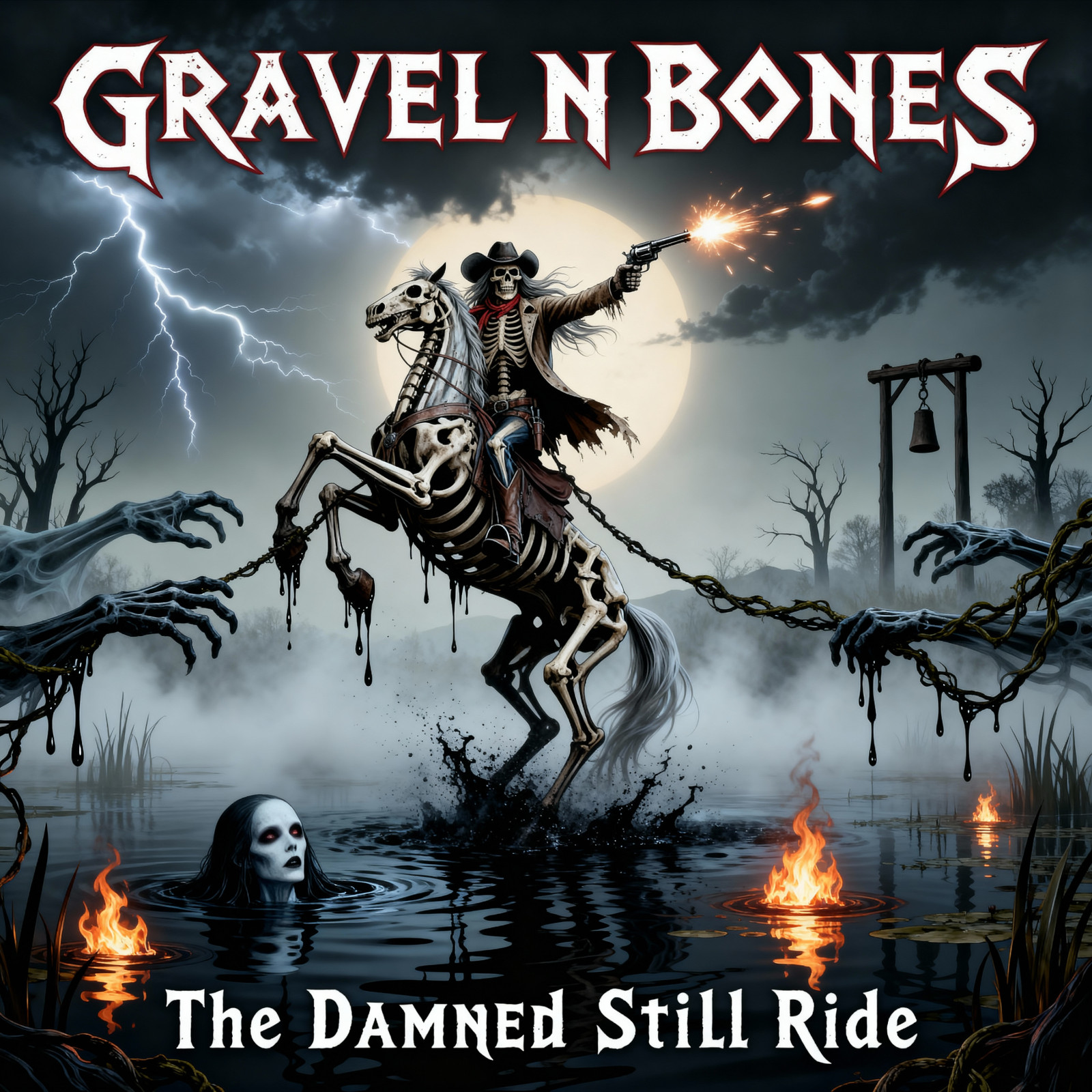
The next chapter in the Gravel N Bones saga, continuing the story begun on Saga of the Damned. The demon rider returns for one more ride into Blackwater.
The Damned Still Ride picks up long after the gunsmoke and grave dirt of Saga of the Damned have settled. The farmer-turned-outlaw, slaughtered with the Black Hand and dragged back from the grave as a demonic rider “more feared than death,” has spent a century as the Devil’s enforcer - the same spectral figure glimpsed in “Devil’s Dust,” riding from town to town to drag the wicked into Hell. But even curses have an ending. This album follows one assignment gone wrong: a single preacher in the swamp town of Blackwater. What starts as just another soul to collect unravels into a reckoning with crossroads deals, faith, innocent blood, and an older, swamp-born power that even Hell didn’t account for.
A century has passed since the farmer died; the Rider has become pure function - Hell’s blade on horseback, cutting down sinners across a dying world. He’s no longer a man seeking vengeance but the Devil’s dust, an immortal instrument of judgment whose humanity is long buried beneath ash, iron, and a hundred years of blood and dust.
On another endless ride, something changes: the Devil burns a new name into his mind - a preacher in a quiet town called Blackwater. Unlike the killers and butchers he usually drags down, this man looks clean, with no visible trail of sin. The Rider feels the first crack in his certainty, but the brand is set; orders are orders, and he rides toward a swamp town that doesn’t seem to deserve Hell’s attention.
Inside the chapel, the Rider confronts the preacher who waits calmly at the cross, fully aware his soul is already claimed. The Rider demands to know why Hell wants him and threatens to burn the whole town - families, fields, and children - if the man won’t confess his debt. When the preacher refuses to explain, choosing faith and silence over a deal, the Rider walks out with fire in his chest and a murderous promise on his tongue: if the truth won’t come from the man, it’ll come from the flames.
As the town teeters on the edge of annihilation, the preacher finally breaks - not for his own sake, but to spare Blackwater. On his knees, he confesses the real sin: years ago he went to the crossroads, signed the Devil’s ledger, and traded his soul for fame, a legend’s name, and the roar of crowds. The “good man” face was just another mask over an old deal. With the debt laid bare, the Rider’s doubts vanish; he brings the flames and sends the preacher’s soul where it was always destined to go.
Blackwater rises in fury the moment the preacher dies. Townsfolk and the sheriff draw iron in the street, determined to kill the thing that burned their church. The Rider reaches for Hellfire to wipe them out, but the power fails - they’re not on Hell’s list, so his curse gives him no flame against them. Forced to fight as something almost mortal, he answers bullets with bullets, mowing them down in a cold, one-sided massacre where their only weapons are lead and prayer against an unstoppable damned thing.
In the aftermath, the town lies broken and the street is lined with bodies. Out of the smoke steps an old woman from the swamplands, shovel in hand, who speaks to him like she’s seen his kind before. She tells him that no curse burns forever, no fire rides without end, and that the earth - and the swamp beyond town - will one day reclaim what Hell stole. Her words plant a deeper fear than any gunshot: a prophecy that there is an end to even the Devil’s flame, and that end waits in the black waters nearby.
Drawn by the prophecy and the pull of something he doesn’t fully understand, the Rider enters the Blackwater swamp and meets the true power that haunts it: a witch wrapped in borrowed beauty and old, rotting magic. Their battle is vicious and surreal - roots, trees, and the swamp itself rise against him as her glamor peels away to reveal the ancient horror beneath. He cuts her down again and again, fighting both her curse and the land she commands, until he finally destroys her… but the swamp has already taken note of his sins.
In the closing chapter, the Rider’s war with the witch and the swamp reaches its true cost. Even with the witch slain, Blackwater Marsh won’t release him; roots coil, mud swallows, and the land pulls him under as if Hell and earth have agreed on his final grave. There are no more souls to take, no more roads to ride - just bones, mud, and dark water closing over the Devil’s favorite hound. The damned still ride… until Blackwater takes him, binding the legend beneath the swamp where judgment can’t reach and the fire finally dies.
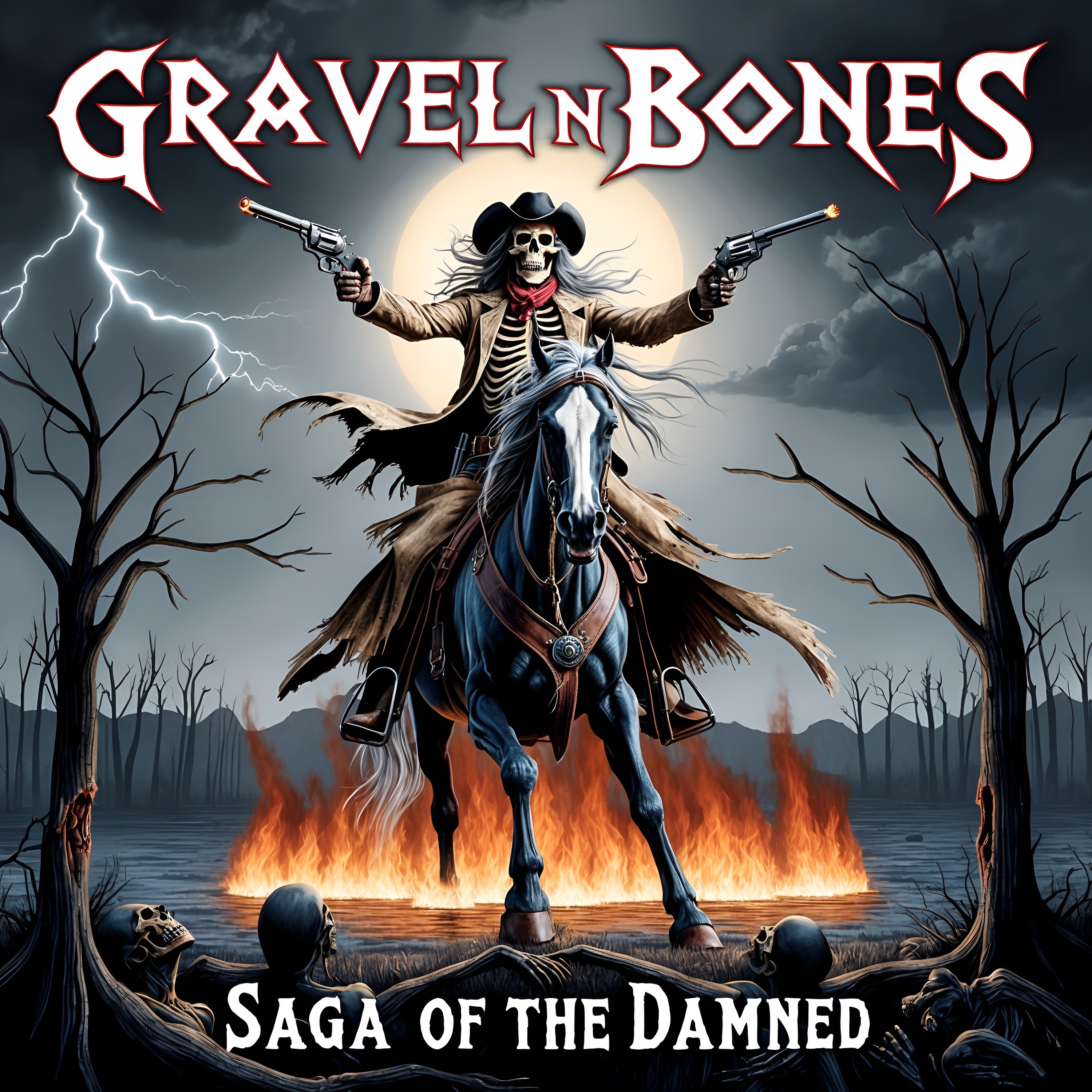
Saga of the Damned tells the tale of a simple man whose life is destroyed by greed and fire. From farmer to vengeful outlaw, from blood-soaked avenger to a demon rider beyond death itself, each song is a chapter in his descent. The album runs like a Western epic - brutal, merciless, and supernatural by its end.
He begins as a humble man working hard on his land. Life is simple, harsh but meaningful. Yet rumors spread of bankers coveting his farm. He vows he’ll never give it up, even if it costs his life.
His worst fear is realized. The banker’s hired men burn his home in the night, killing his wife and young daughter. He wakes to the smoldering ruins and the silence of loss.
Seeking justice, he turns to the sheriff, the church, the community - but no one will help him. The law is bought, the townsfolk are silent, and the church offers hollow words. His faith in justice is shattered.
His first act of revenge. He hunts down one of the arsonists alone. The kill is messy, brutal, not heroic. It’s the first time his hands are stained, and though it brings no peace, he feels the pull of vengeance.
He falls in with the Black Hand, a ruthless gang of killers and gamblers. Around a smoky card table, he proves himself by violence and is welcomed in. He abandons the man he was and embraces the outlaw’s path.
With the Black Hand at his side, he hunts the men who burned his family alive. One by one they fall in a bloody ambush. He tortures one for the name of the banker who paid them, then kills him without hesitation.
The final strike. He and the Black Hand storm the banker’s guarded house. A violent firefight ends with the outlaw dragging the banker into his iron vault, dousing it with kerosene, and burning him alive among his gold. In this act, the last of his humanity dies.
With vengeance complete, he realizes he can never return to the man he was. He is now a murderer, feared and hunted. There’s no redemption, no peace - only the outlaw life.
His descent deepens. Drunk, violent, reckless, he kills without reason. Wolves gather in his wake, drawn to the smell of blood. The bottle and the gun have consumed him.
Now infamous, crows follow his trail like omens of death. Wanted posters cover every town, but every posse sent after him ends up in the dirt. He embraces the legend of his cruelty, knowing he’s become death riding on horseback.
The law finally gathers enough men to crush him. After a bloody bank robbery, the Black Hand is ambushed in a canyon. His crew is slaughtered, and he himself is shot down and buried in a shallow grave. It seems like the end - but Hell won’t let him die.
The finale. Dragged from the grave by the Devil’s hand, he rises as something not human - a demon outlaw. He rides from town to town dragging men’s souls to Hell, unstoppable, eternal, more feared than death itself. He becomes the entity protrayed in the song Devil’s Dust from the album Graveyard Psalms
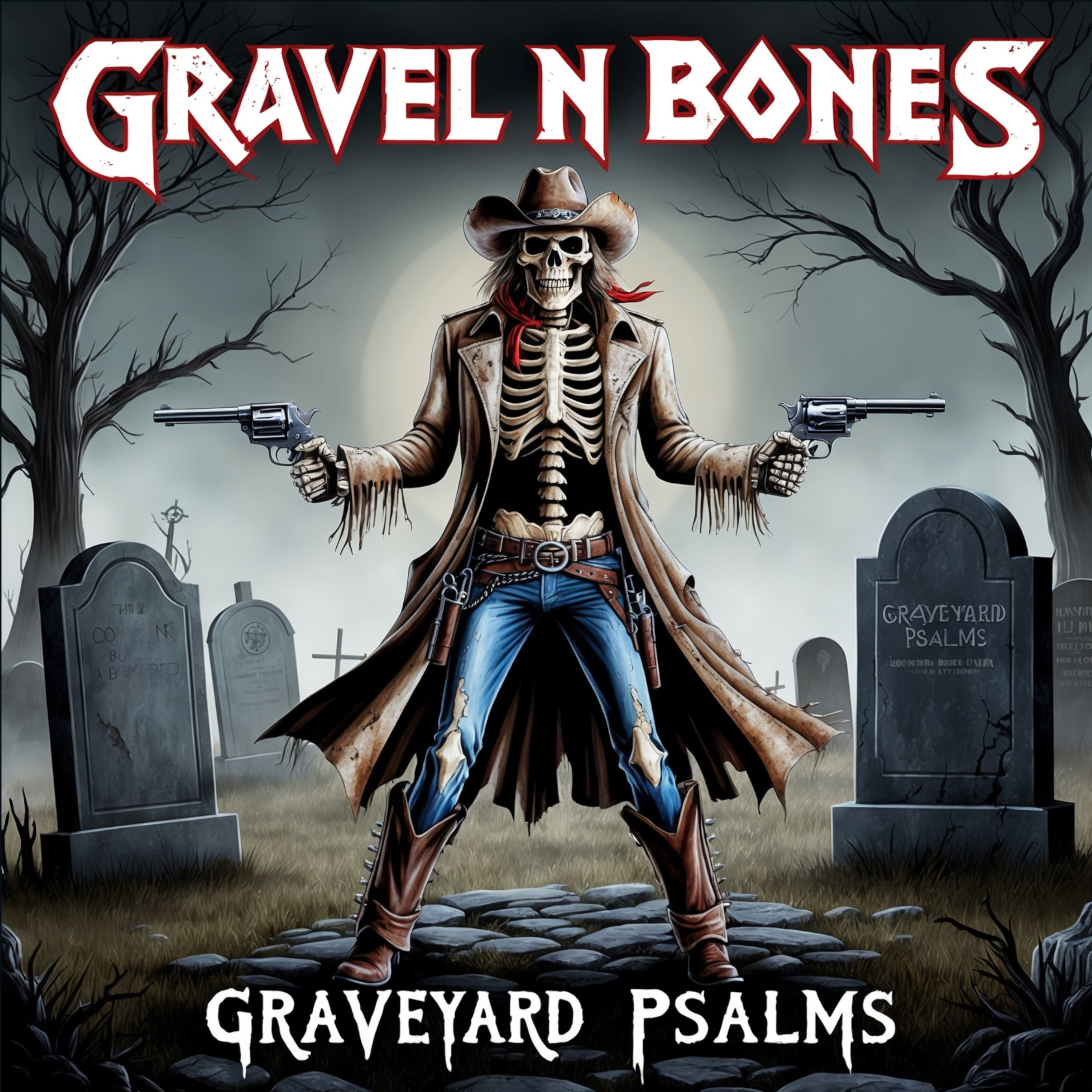
Gravel N Bones blends Country, Dark Country, and Southern Rock on Graveyard Psalms, a brooding debut forged with gothic edges and outlaw grit.
For general info or press, send us a message below.
Beyond Spotify and YouTube Music, every Gravel N Bones release is available on:
Apple Music · Amazon Music · Pandora · Tidal · Deezer · iHeartRadio · Audiomack · Anghami · Boomplay · JioSaavn · KKBox · Yandex.Music
Search “Gravel N Bones” on your preferred platform.